
Retail Arbitrage for Beginners: A Practical Sourcing Guide
You're in the aisle with your phone in one hand, a clearance tag in the other, and a line of shoppers behind you. The price looks good, the product looks familiar, and your first instinct is to buy it before someone else does. That's exactly where beginners make expensive mistakes, because retail arbitrage isn't about grabbing cheap inventory, it's about buying items that still leave room for fees, shipping, and a real profit after the sale clears.
Table of Contents
- What Retail Arbitrage Actually Looks Like in Practice
- Building Your First Sourcing Workflow
- Calculating Net Profit Before You Buy
- Using AI Tools to Speed Up In-Aisle Decisions
- Common Beginner Mistakes That Kill Profitability
- Legal Basics and Tax Obligations for Resellers
What Retail Arbitrage Actually Looks Like in Practice
You're standing in a Target clearance aisle, staring at a stack of marked-down headphones. One box says $12.99, another says $9.99, and both look like they could flip for more online. The key question isn't whether they're cheap, it's whether they've sold recently at a price that still leaves enough room after platform fees, shipping, and returns.
The in-store decision happens fast
That's the rhythm of retail arbitrage in practice. You're comparing what you can buy locally against what the item has recently sold for on eBay, Poshmark, Amazon, or another marketplace, then deciding whether the margin is worth the risk. If you're doing it well, you're not browsing for fun, you're making a buy-or-pass call in seconds.
Practical rule: cheap inventory is not good inventory unless the net math works after every cost you'll actually pay.
The model appeals to side-hustle sellers because the entry point is low and the sourcing is flexible. It also works for full-time resellers who already know how to spot demand patterns in clearance sections, thrift racks, and outlet shelves. The work is repetitive, but the upside is that you can start with a small cart, a scanner, and a clear set of filters instead of a warehouse full of unsold stock.
What separates it from other sourcing models
Retail arbitrage is different from wholesale because you're not buying from distributors in bulk, and it's different from online arbitrage because the sourcing happens in physical stores, not only on websites. That matters because the shelf tells part of the story, but not the whole story. A box may look promising in person and still be a poor buy if the sold comps are weak or the fees eat the spread.
The best beginners treat each store trip like a quick research session, not a treasure hunt. They scan, compare, reject fast, and only buy when the numbers support it. That mindset keeps the process grounded and keeps emotion out of the cart.
Building Your First Sourcing Workflow
Start small enough that you can think. One of the most practical beginner rules is to limit your first trip to 2-3 stores, scan 20-30 clearance items, and only buy a test batch of 3-5 items once the math makes sense, because that sequence keeps you from overcommitting before you know what works. A staged trip like that forces you to learn the process without turning one shopping run into a pile of mistakes.
Pick stores that make research easy
Big-box clearance sections are usually the easiest place to learn because the inventory is organized and the prices are visible. Thrift stores and outlet malls can also work, but they're more variable, which means your eye has to do more of the sorting. For a first outing, you want categories and shelves that let you practice scanning without getting buried in mixed-condition chaos.
A practical loop looks like this, walk the aisle, scan a few items, check sold comps, and move on. Don't stand in one spot long enough to second-guess every decision. The goal is to build a repeatable habit, not to prove you can research forever.
Keep the first week about repetition, not volume. Repeating the same research pattern builds speed faster than chasing every shiny item in the store.
What to do on the floor
Use the same order every time. First, check whether the item is even eligible to sell on the platform you use. Then check whether demand is real, which means looking at sold comparables rather than active listings. After that, run the fee math before you ever put it in the cart.
If the numbers look borderline, walk away. Beginners usually lose money by buying items that feel “close enough,” then discovering later that shipping, prep, and returns turned the deal into clutter. A clean workflow makes the buy-or-pass choice easier because it removes guesswork.
For a deeper market-value process, use the sourcing research approach outlined in this market value research guide.
Calculating Net Profit Before You Buy
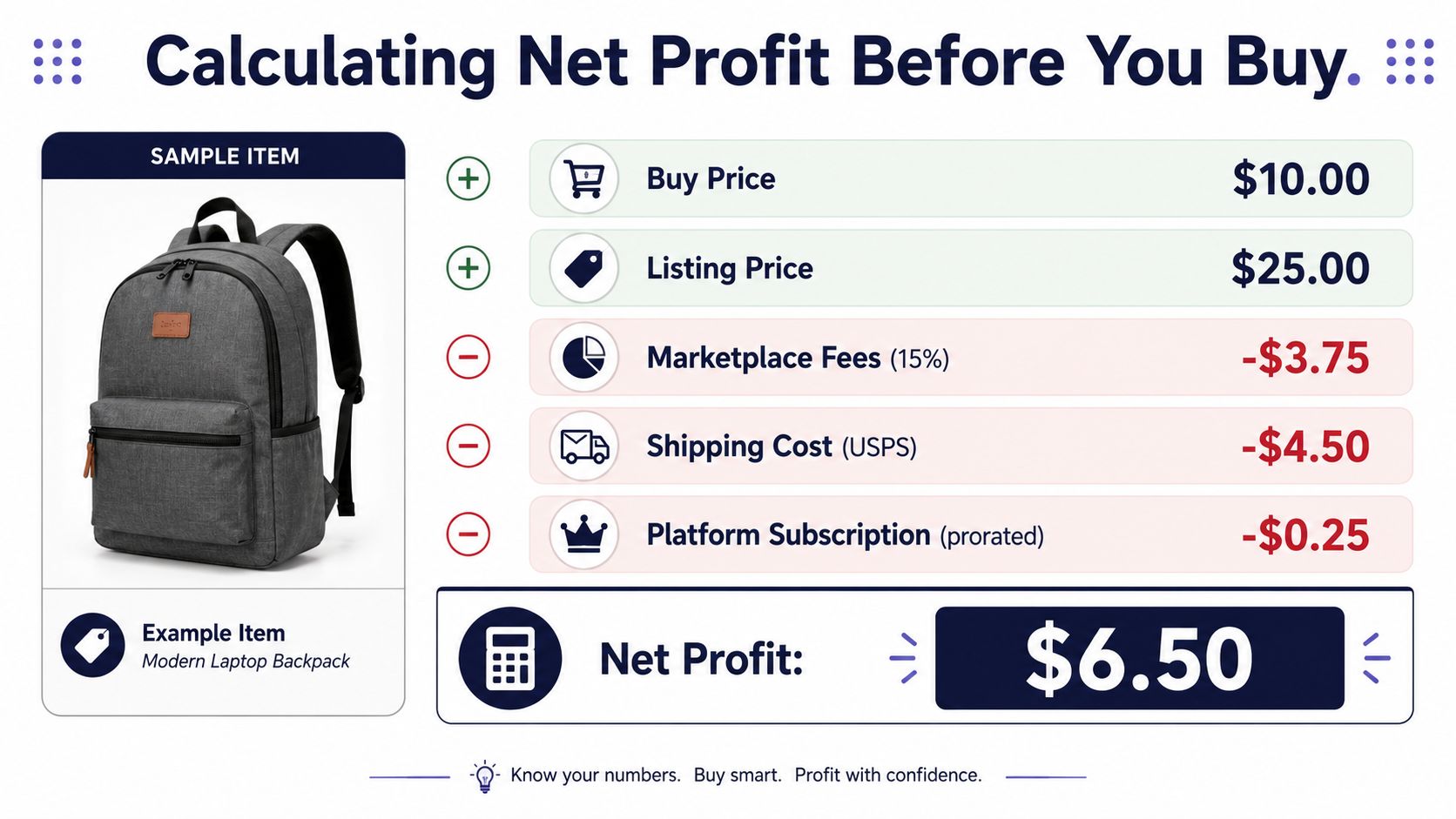
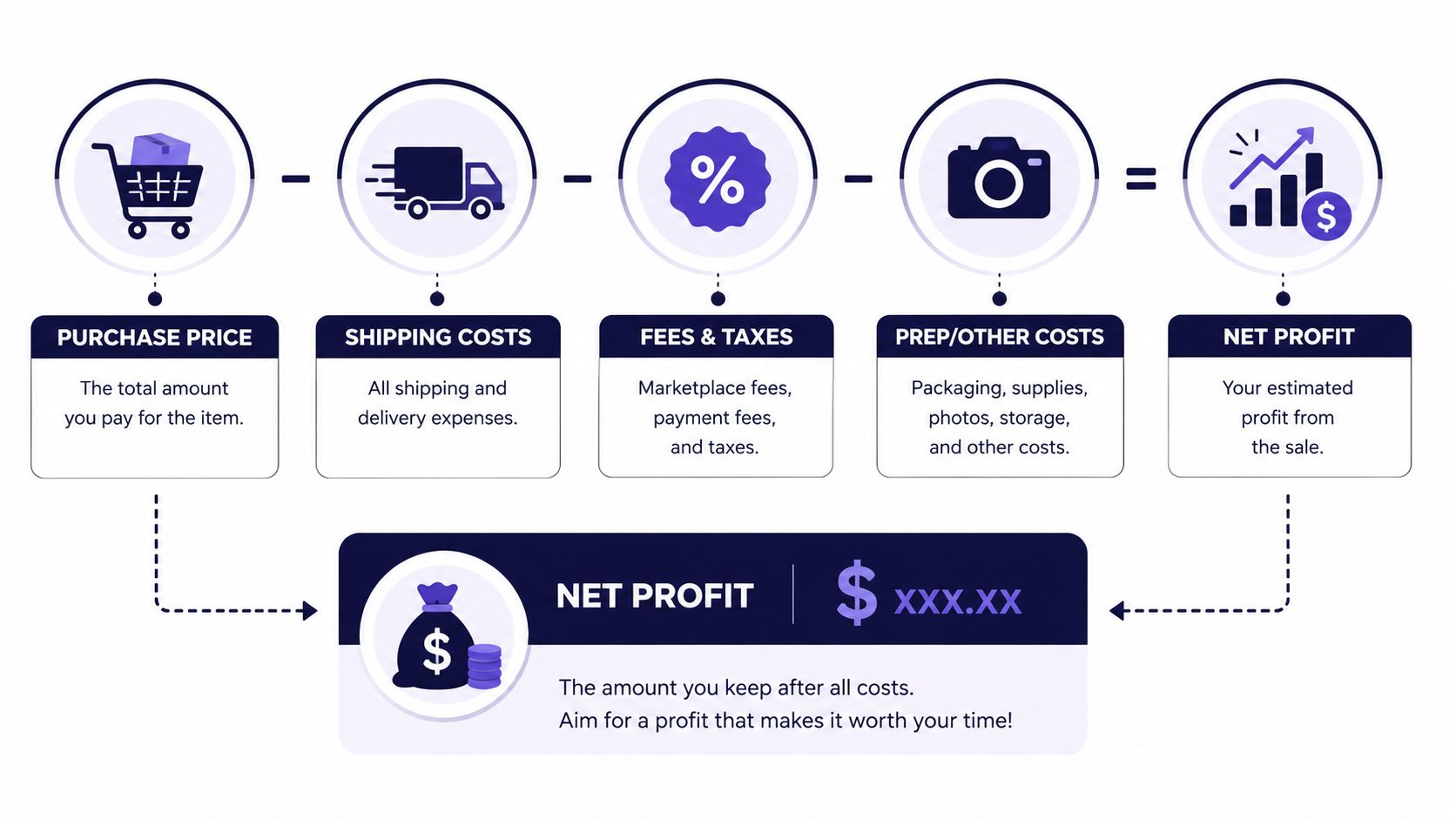
A shelf tag can lie by omission. It tells you what you'll pay at the register, but not what you'll keep after the sale, and that's the only number that matters. The beginner mistake is obsessing over spread, then ignoring the costs that steadily strip the margin away.
Net profit beats gross spread
A $10 item that only nets $2 after marketplace fees and shipping is a 20% ROI, which is below the common beginner benchmark in retail arbitrage. That's why experienced sellers filter by net profit, not by “looks like a deal” logic. The common beginner target is more than 50% ROI and at least $3 profit per unit after fees and shipping, while one technical workflow used by experienced sellers is to scan for products with BSR under 100K, 30%+ ROI after fees, and no restrictions before buying, after scanning at least 50 clearance items onlinesellingexperiment.com underpriced.app.
That's the right lens because retail arbitrage is a thin-margin business. If the item looks profitable only before deductions, it usually isn't profitable at all. Price spread is the first screen, not the final answer.
Useful habit: calculate profit as if the item will take the hardest reasonable path, then buy only if it still passes.
How to think about fees without freezing up
Every marketplace takes its cut differently, and shipping changes the math again. eBay, Poshmark, and Amazon all eat into your margin in their own way, so the number on the listing page is never your take-home. The practical move is to use a fee calculator or a scan tool that bakes in the deductions before you commit.
A simple in-aisle test works well. Ask yourself whether the item still clears your profit floor after fees, shipping, and a little room for price movement. If it doesn't, the answer is no, even if the gross spread looks exciting.
That's also why a $15 thrift store item that sells for $45 can still be a mediocre purchase if the leftover profit is too small. The sale price matters, but the money you keep matters more. Beginners who build the habit of checking net profit early avoid the trap of filling bins with inventory that only looks good on the shelf.
For a fuller breakdown of the math, use the net profit method in this calculation guide.
Using AI Tools to Speed Up In-Aisle Decisions
Manual research works, but it slows you down. Toggling between eBay, Poshmark, and Amazon while standing in a store is awkward, and the more tabs you open, the easier it is to misread a comp or skip a fee. That delay matters because sourcing is a speed test as much as it is a math test.
Manual lookup versus tool-assisted scanning
With manual lookup, you identify the item, search it by brand and model, check sold comps, then estimate fees in your head or in a separate calculator. It's workable for a handful of items, especially if you already know the category. It gets painful in a store full of mixed merchandise, where the time spent on each scan starts to kill momentum.
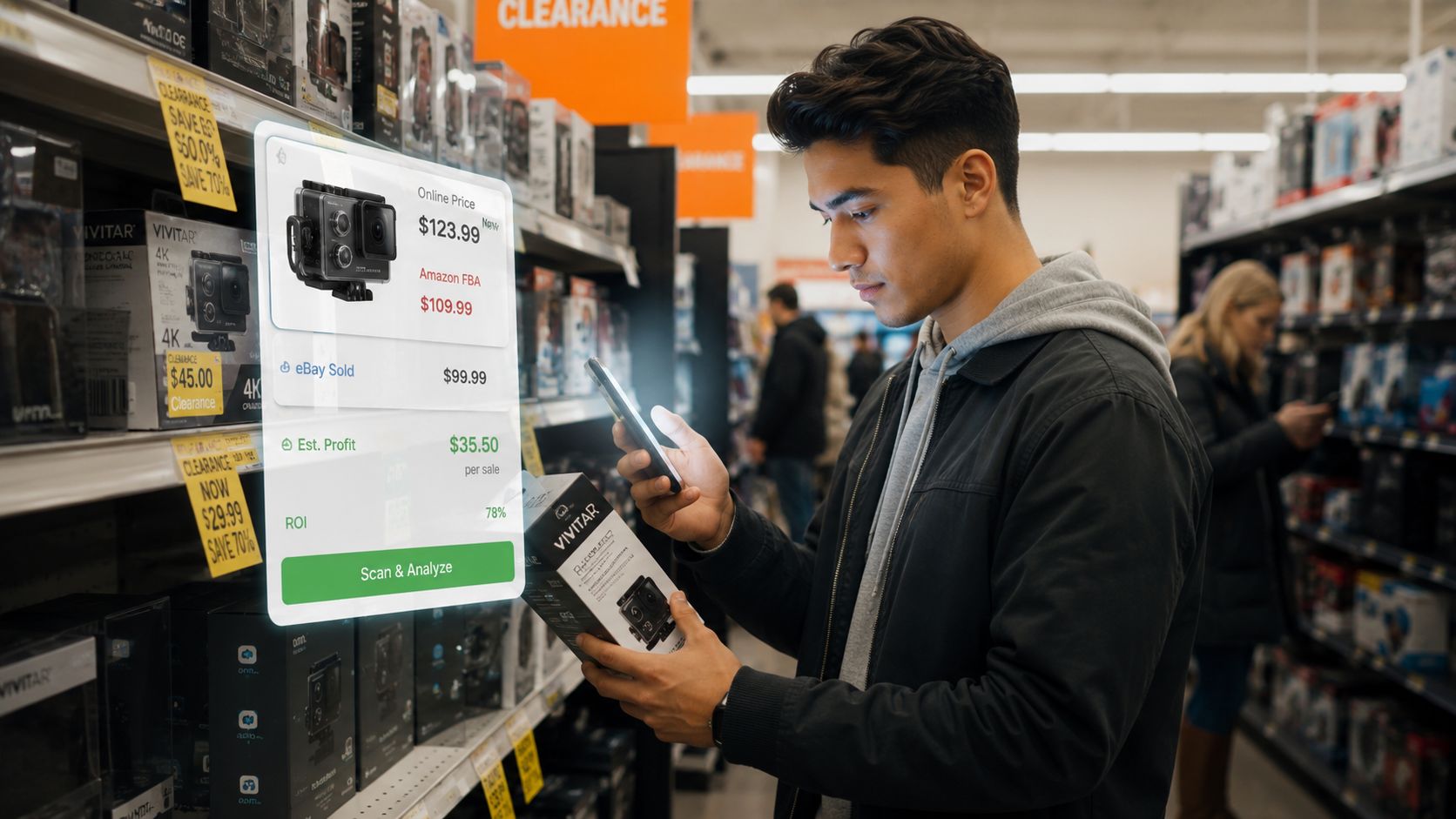
Tool-assisted workflows compress that process. A strong sourcing app can identify an item from a photo, even when there's no barcode, and surface sold comparables across multiple marketplaces in one view. That matters for shoes, vintage clothing, collectibles, and other inventory that doesn't always have a clean UPC to scan.
The advantage isn't just convenience. Faster research reduces hesitation, which is often what causes a good item to get left behind.
Where speed changes the outcome
The difference shows up when the shelf is crowded and the item is unusual. A vintage jacket, an untagged pair of boots, or a collectible with partial labeling can take several minutes to research manually. If the store is busy, that's often enough to make you pass or guess.
A good scan-to-decision flow keeps the logic visible. You identify the item, check recent sold comps, run the fee math, and compare the result against your threshold before you move on. That's a cleaner process than relying on memory or guessing based on the listed price spread.
ScanFlip AI is built around that sourcing-stage workflow, with visual identification, consolidated sold comps, and net-profit output for fast buy-or-pass decisions. More on the app's retail-arbitrage workflow is available in the retail arbitrage app overview.
Common Beginner Mistakes That Kill Profitability
Most beginners don't fail because they can't find items. They fail because they buy the wrong ones for the wrong reasons. The shelf feels exciting, the price is low, and the cart starts filling before the math gets a fair shot.
The mistakes that show up over and over
The first bad habit is chasing items with weak sales velocity. If an item sits for months, the carrying cost and time cost keep stacking while your cash stays trapped. The second is ignoring condition problems, which leads to returns, refunds, and annoyed buyers who were expecting something cleaner than what arrived.
Another common mistake is treating “like new” as if the market agrees with that phrase. Buyers don't care about the label if the item has wear, missing parts, or a smell that ruins the listing photos. Condition is part of the profit calculation because damaged or questionable inventory often takes longer to sell and brings more headaches than margin.
The mindset errors are just as costly
Beginners also get seduced by active listings instead of sold comps. Active listings tell you what sellers hope to get, not what buyers are paying. That's why a cart full of “possible winners” can still turn into dead stock.
The other trap is buying too much before validating demand. A few good test purchases teach more than a bulk haul built on optimism. Experienced sellers keep the first buy small until the item proves it can move at a price that leaves room for fees, shipping, and time.
Legal Basics and Tax Obligations for Resellers
The legal and tax side gets ignored until the bins are full and the spreadsheet is messy. That's backwards. Before you scale, you need to know whether you're operating as a business, what records you're keeping, and whether the platform or category you're buying into has restrictions that could block the sale later.
The checklist that keeps you out of trouble
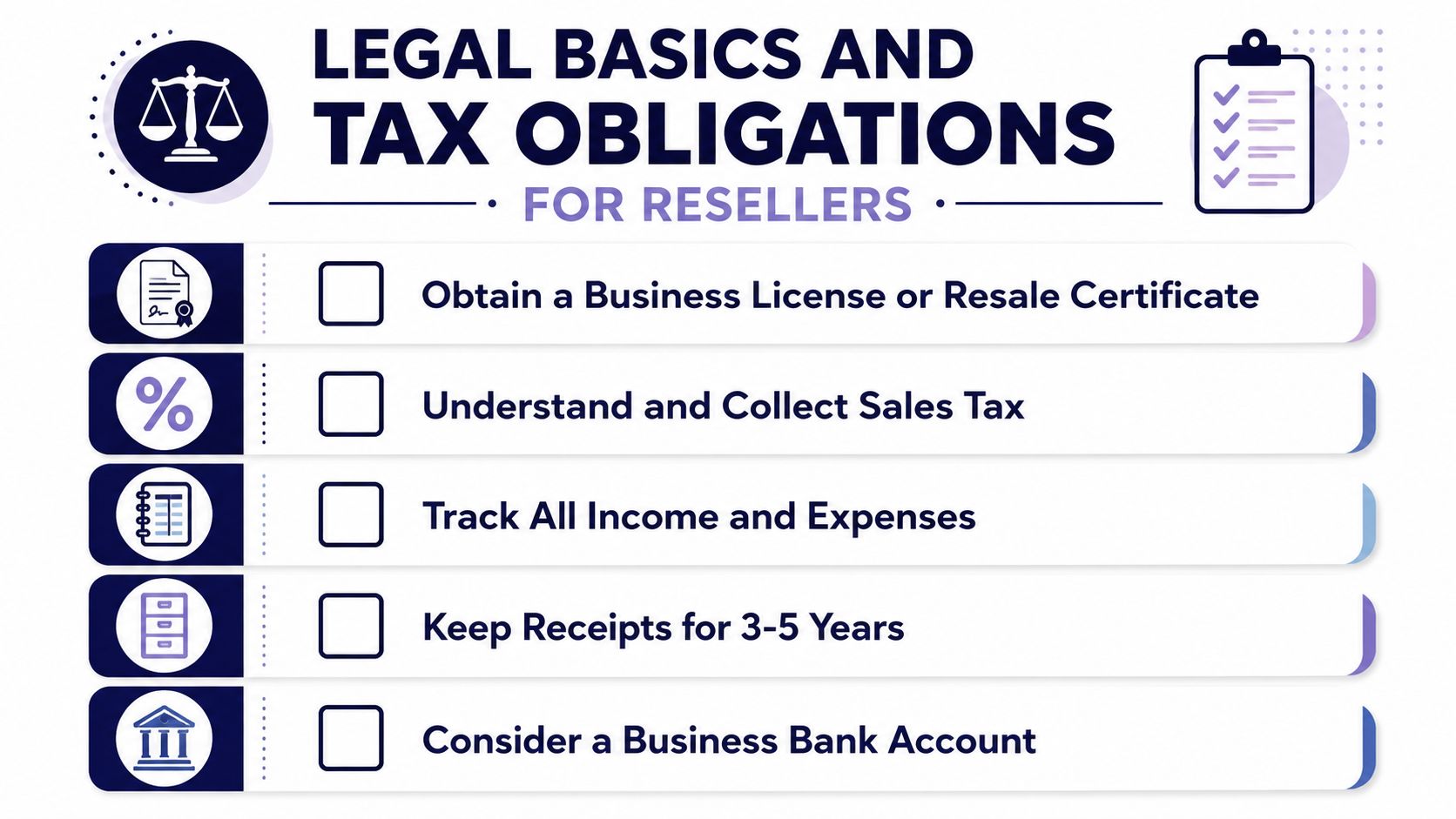
At minimum, get clear on whether you need a resale certificate or business registration in your area, then understand how sales tax is collected on the marketplace you use. Keep every sourcing receipt, every fee record, and every shipping expense, because those records are what make the math defensible later. If you're selling on Amazon, check eligibility before buying because gated categories and brand restrictions can make a perfectly good item unsellable.
Practical rule: if you wouldn't want to explain the purchase to a tax preparer or marketplace support rep, don't buy it yet.
The business-versus-hobby question matters too, because your recordkeeping should match the way you operate. Once you start sourcing regularly, tracking income and expenses becomes part of the job, not an optional admin task. A separate bank account can also make it easier to see what's really happening with cash flow instead of mixing reseller activity with personal spending.
The legal side doesn't make retail arbitrage less attractive. It just keeps the business clean enough to survive long enough to matter.
If you want a faster way to make buy-or-pass calls in the aisle, ScanFlip AI is built for that exact moment. It identifies items from photos, pulls sold comps across major marketplaces, and calculates expected net profit so you're not guessing while standing in front of the shelf. Visit it when you're ready to turn faster scans into cleaner sourcing decisions.