
Target Return Without Receipt Limit: A Reseller’s Guide
A stack of unopened Target clearance items looks like easy inventory when you're standing in a Goodwill aisle or sorting an estate-sale table. Then you scan a Cetaphil gift set, see a $22 margin, and mentally designate Target Guest Services as your backup plan.
That assumption gets expensive. The Target return without receipt limit isn't a free insurance policy for unsold stock, missing inventory, or a bad buy. The outcome can be an approval, a denial, or a merchandise return card that ties your money to future Target spending. Price that risk before you buy, not after the item has already joined your death pile.
Table of Contents
- When the Receipt Isn't in Your Hand
- How Target's No-Receipt Return Policy Works Today
- The ID-Linked Annual Limit Resellers Keep Hitting
- In-Store Versus Target.com Versus Target Plus Partners
- Category Exceptions That Change the Math
- Gifts, Opened Items, and Merchandise Return Cards
- Sourcing Tips to Protect Your Flip Margin
When the Receipt Isn't in Your Hand
The number to budget around is approximately $100 in merchandise value per year for no-receipt returns tied to your identification. Treat that as a practical ceiling, not a promise that every item below it will be accepted. Target can still deny the return, approve it only as a merchandise return card, or require proof of purchase before completing the transaction.
That risk belongs in the sourcing decision. A reseller who finds unopened clearance goods at a thrift store or estate sale should price the return exposure before buying. Scan the item with a tool such as ScanFlip, check the expected margin, then ask whether the deal still works if the product cannot be returned for cash.
The Cetaphil gift set shows why this matters. The scan suggested a $22 margin, and the sealed package looked easy to liquidate. Three days later, Target Guest Services could not resolve the inventory trail. The return was downgraded to a merchandise return card instead of going back to the original payment method.
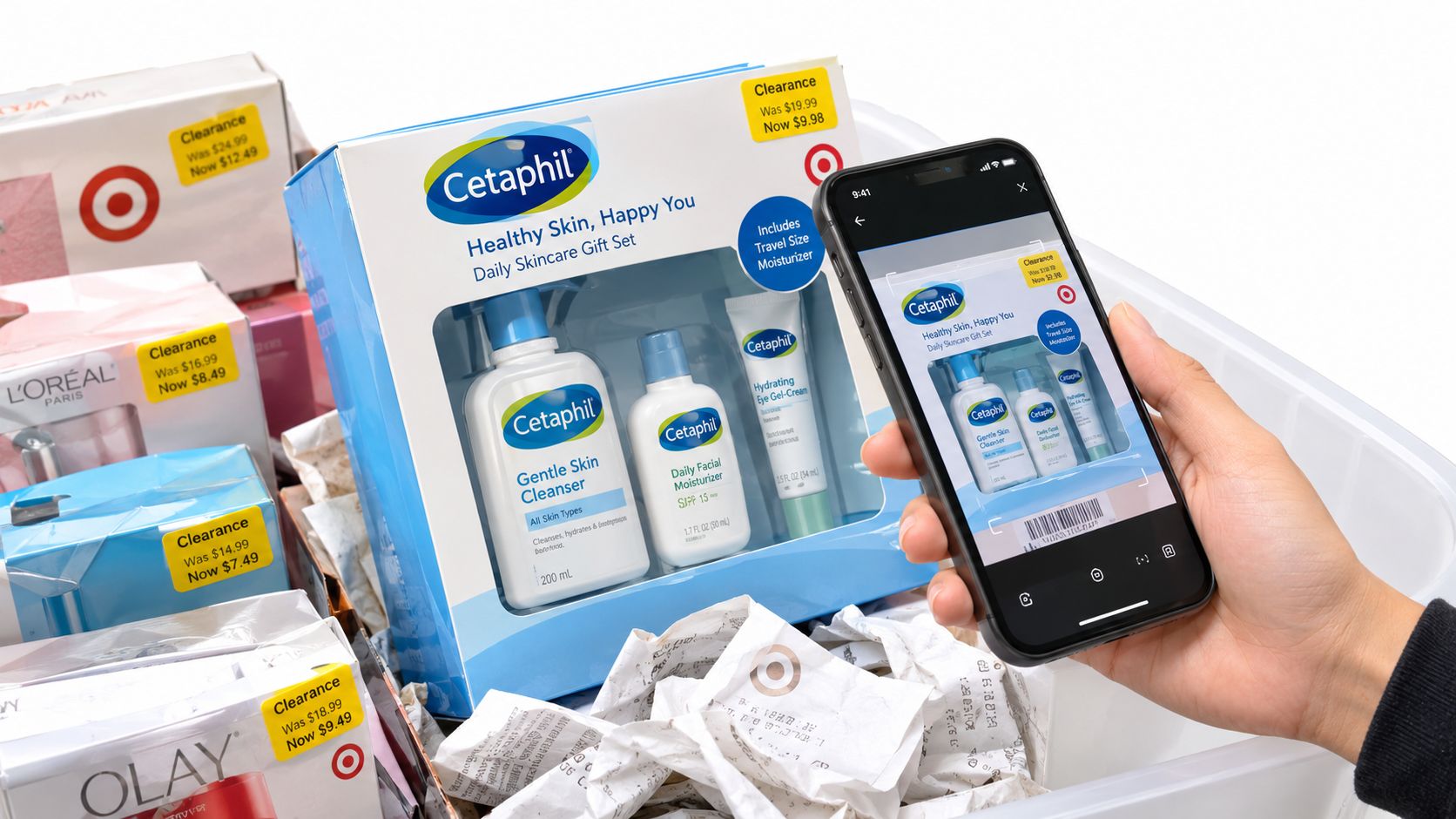
A merchandise return card preserves some value, though it does not provide the same liquidity as cash. You may have to spend it on another Target purchase, accept a lower recovery, or hold it until a suitable use appears. That delay can erase the expected profit when the item is seasonal, discontinued, or already oversupplied on eBay.
Practical rule: Treat a receiptless Target return as a possible recovery route, never as guaranteed protection for cost of goods.
The policy has changed over time. In 2009, Target replaced a rule allowing only two non-receipt returns in a 12-month period, with each item capped at $35, with a rule allowing unlimited non-receipt returns up to $70 in merchandise value over 12 months, according to the Star Tribune's coverage of Target's return-policy change.
For resellers, the dollar ceiling is only one variable. Purchase verification, item eligibility, return timing, and the available refund method determine whether a bad buy becomes recoverable inventory or a loss tied up in store credit.
How Target's No-Receipt Return Policy Works Today
Start with the ordinary return window. Target's standard policy generally gives most eligible merchandise a 90-day window, but the window doesn't override product-specific rules, condition requirements, proof-of-purchase controls, or channel restrictions.
At the desk, the process usually works in this order:
The associate checks for proof of purchase. A paper receipt is only one option. Target may locate the transaction through the payment card used at checkout, including a credit card, debit card, or RedCard, or through a gift receipt. A Target.com order can also be supported by the account record, return barcode, confirmation email, or digital purchase history.
The system checks the item and the guest record. The barcode, purchase information, return date, and identity details can determine whether the transaction qualifies. A missing paper receipt doesn't automatically mean the purchase is invisible, but a missing digital or payment trail creates a much weaker position.
The store decides whether a no-receipt path is available. Target's official returns and exchanges policy says an in-store return without an eligible receipt can be denied. It also says returns without proof of purchase may be limited and may result in a merchandise return card instead of reimbursement to cash or the original payment method.
A manager may review an exception, but that isn't a second standard return lane. A manager override still depends on the item's condition, available transaction information, category rules, and the account or ID history attached to the return. Being polite helps the conversation. It doesn't erase the system's controls.
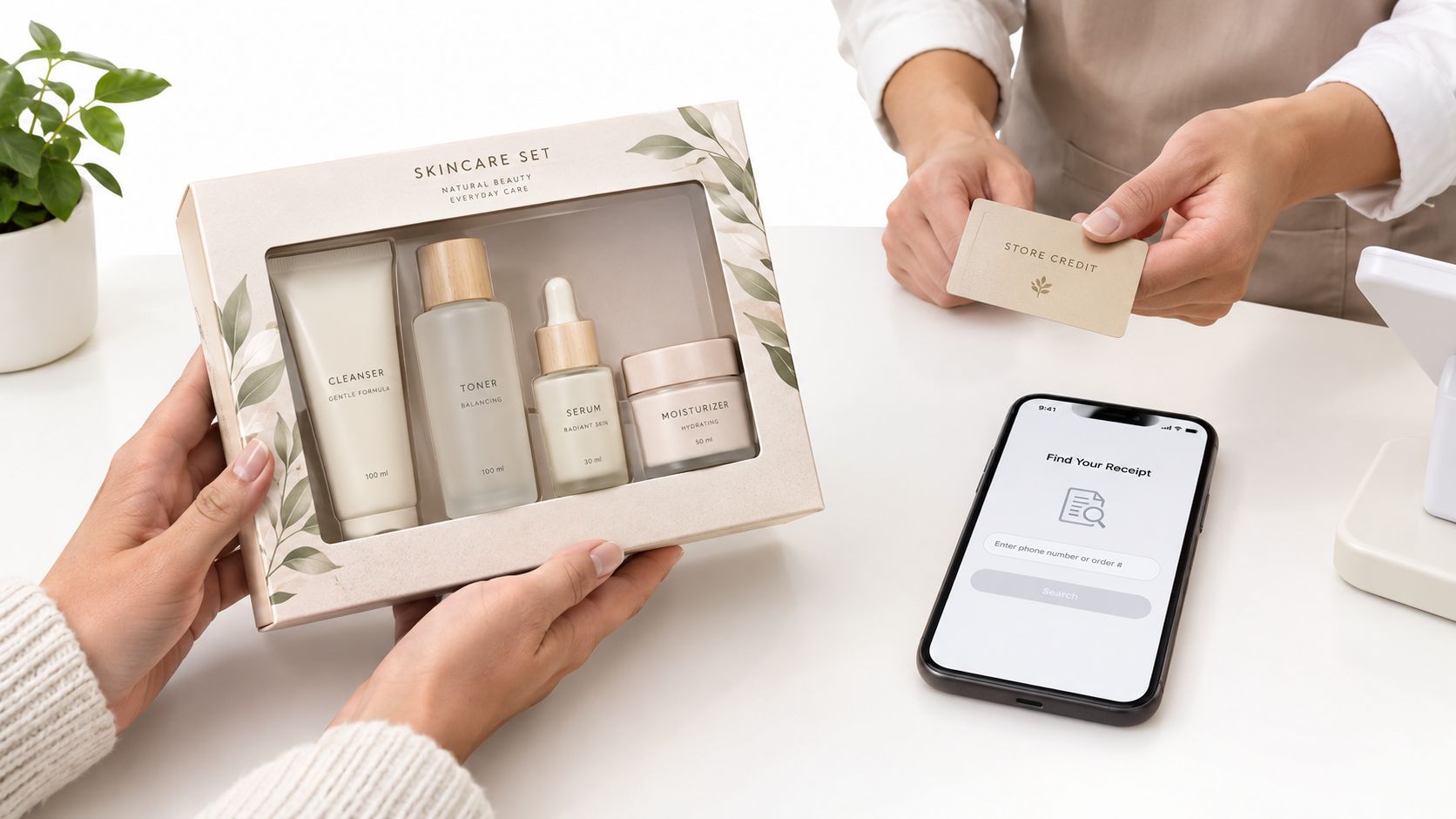
A merchandise return card is store credit. Its value depends on what Target's system can verify for the item and transaction, not necessarily the price you paid at an estate sale or the resale value shown by sold comps. It can't be treated like a cash refund, and it won't restore marketplace fees, shipping, or the time spent moving the item between platforms.
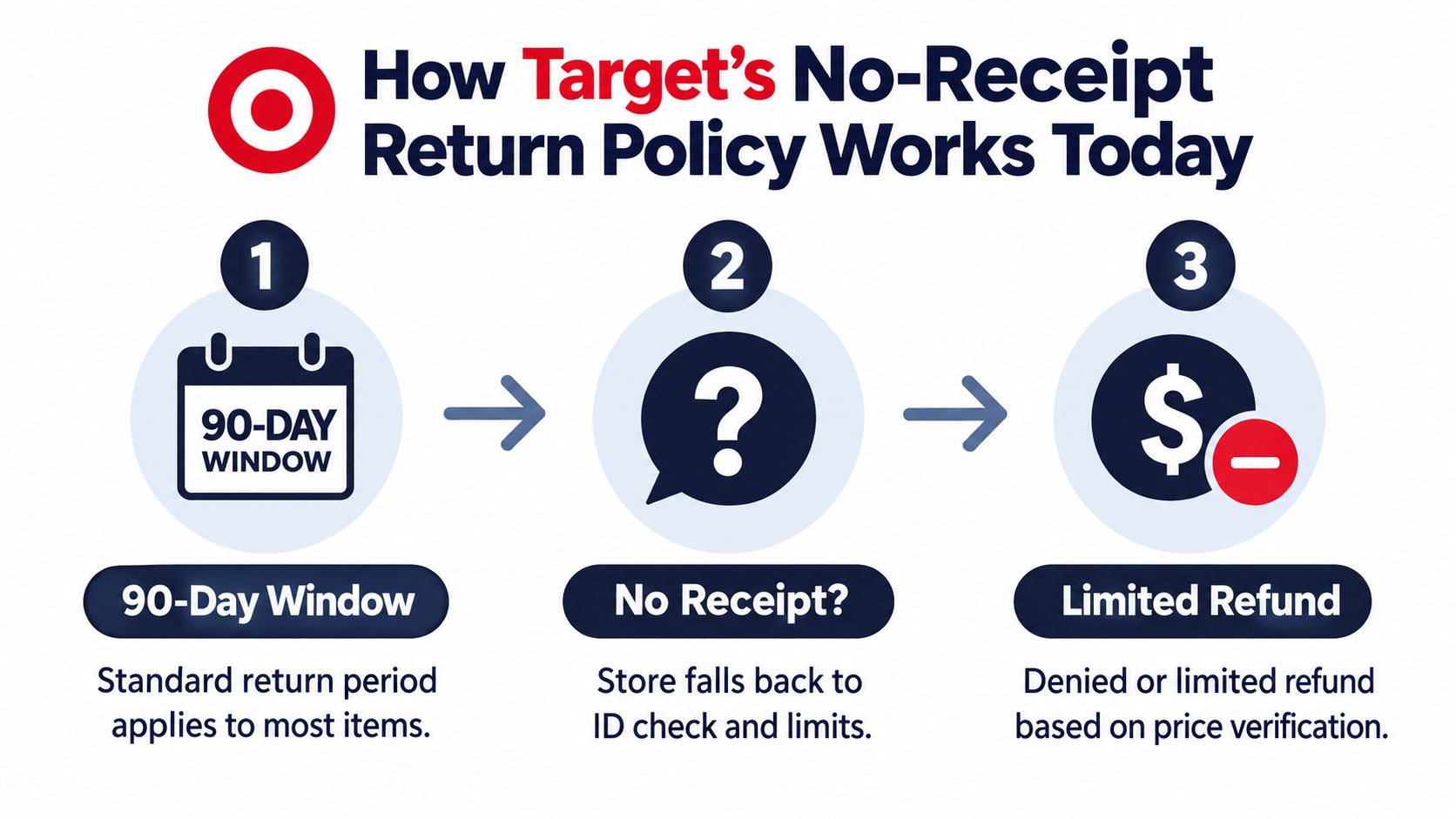
Digital proof now matters more than a paper receipt. Target highlights app return barcodes, receipt lookup through a Target account or the card used at checkout, and wallet-based digital records in its official guidance on replacements and exchanges. That shift makes the practical limit less like one universal dollar figure and more like a verification decision attached to the buyer, item, payment method, and channel.
The ID-Linked Annual Limit Resellers Keep Hitting
A no-receipt return limit belongs in the sourcing decision, not at the Guest Services desk. Before scanning a clearance item with ScanFlip, price in the possibility that a future return will be denied or reduced to a merchandise return card. The expected resale margin is only part of the calculation. Your available proof, return history, item category, and ID-linked allowance can determine whether the fallback exit exists.
Target's older policy change is useful background, but it does not give resellers a dependable rule for current transactions. The historical report on Target's policy change documents that earlier framework. Current guidance says no-receipt returns may be limited, while independent consumer guidance describes a reported ceiling of roughly $100 annually tied to ID. Treat that amount as a practical reference, not a guaranteed allowance for every guest, category, store, or transaction. The same consumer guidance on Target's return process describes denial of online no-receipt returns.
What the ID check looks like
At Guest Services, the associate may scan a driver's license or other accepted ID and check details connected to the return. A phone number, email address, Target account, payment record, or prior transaction data can connect separate visits to the same guest. The system can therefore evaluate the new item alongside earlier receiptless returns, even when the item is unopened and still within its return window.
The associate may see an approval, a merchandise return card option, or a denial. A manager can review an exception, but the review still depends on item condition, category rules, available transaction information, and the history attached to the guest record. Polite communication can help clarify the facts. It cannot remove a system restriction.
Why resellers reach the ceiling faster
A household might make occasional returns. A reseller may buy several clearance units, test demand, and bring slow movers back after separate sourcing trips. That pattern creates repeated Guest Services activity in a short period. Each return can appear valid alone while the combined history pushes the next request into a different decision.
The reported ceiling is not necessarily portable across categories or locations. An item with special handling, an item lacking verifiable purchase information, or a refund request outside the usual payment path may receive different treatment. One store associate may also be unable to ignore a restriction attached to the guest record at another location.
| Return factor | What it can change | Sourcing implication |
|---|---|---|
| ID-linked history | Whether another receiptless return is approved | Preserve room for genuine returns |
| Item category | Eligibility and refund handling | Check restrictions before buying multiples |
| Purchase verification | Cash refund, store credit, or denial | Keep receipts and digital records |
| Store review | Whether an exception is considered | Do not assume another location resets the result |
Rotating stores or payment methods is a poor sourcing plan. It does not create proof of purchase, remove category restrictions, or guarantee a fresh allowance. It may also look like an attempt to avoid return controls. Record each purchase, preserve digital proof, and reject inventory whose margin depends on a no-receipt return being approved later.
In-Store Versus Target.com Versus Target Plus Partners
The purchase channel changes the return problem before an associate ever scans the item. An in-store purchase may be recoverable through the original card or a digital lookup, while a Target.com order normally leaves an account record, confirmation, and return barcode. A Target Plus Partner purchase follows a third-party seller's transaction and proof-of-purchase requirements rather than the same path as ordinary Target inventory.
The three channels at a glance
| Channel | Proof of Purchase | Refund Method | Reseller Takeaway |
|---|---|---|---|
| In-store Target purchase | Paper receipt, eligible payment-card lookup, gift receipt, account record, or other digital proof | Original payment method when verified, or merchandise return card where allowed | No receipt can lead to a denial, so record the payment trail before leaving |
| Target.com order | Target account history, order confirmation, return barcode, or digital receipt | Usually follows the verified order and its payment record | Digital proof is stronger than relying on memory or a product barcode |
| Target Plus Partner item | Proof of purchase connected to the partner order | Follows the partner's return and refund process | Check the seller's terms, shipping responsibility, and eligibility before buying |
Target's help page says most Target.com items can be returned in store only with a valid receipt or return barcode. It also states that Target Plus Partner items require proof of purchase, a distinction covered in Target's guidance for online and partner returns.
That distinction matters when you're buying inventory from liquidation, estate sales, or another reseller. A Target barcode doesn't prove that you own a returnable Target.com transaction. It identifies the item, but the retailer may still need the order record, return barcode, or partner purchase information.
A product can be genuine Target merchandise and still lack a usable Target return path.
For resellers selling on several marketplaces, this is also why return assumptions should stay separate from your sales workflow. A guide to selling on multiple platforms can help organize channel decisions, but no crosslisting process replaces Target proof of purchase. If the item came from Target Plus, save the order details and partner name. If it came from a store, record the card or account that may support a lookup.
Category Exceptions That Change the Math
The standard return window doesn't make every category equally safe to source. Product condition, brand, and category exceptions can shorten the practical exit window or eliminate the receiptless route altogether.
Opened Apple products deserve the most caution. Target's exception language treats certain consumer electronics under the “All Hands Must Be On Deck” category, where opened Apple products can have a 30-day return window to Target instead of the standard 90-day period. A box that looks complete to a reseller may still fail if the product was activated, opened, missing an accessory, or subject to a stricter verification rule.
Beauty creates a different problem. Skincare, cosmetics, and personal-care products usually need to be mostly unopened, and an opened cosmetic can be declined even when it appears unused. A seal that has been broken changes the condition assessment, and no amount of resale demand fixes that at the desk.
Category checks before the buy
Consumer electronics: Confirm the exact product rule, activation status, accessories, and return deadline. A sealed device can still carry a narrower return path than general merchandise.
Beauty and personal care: Treat intact seals as part of the product's value. If you can't verify that the item is unopened, price it as final-sale inventory rather than assuming Target will take it back.
Gaming and media: Check whether the package has been opened and whether the category has its own restrictions. A resale buyer may accept an opened game, while Target may not accept it as a return.
Target-exclusive brands: Don't assume every owned-brand item follows the same timeline. Check the current policy page and store signage before assigning a return value to the item.
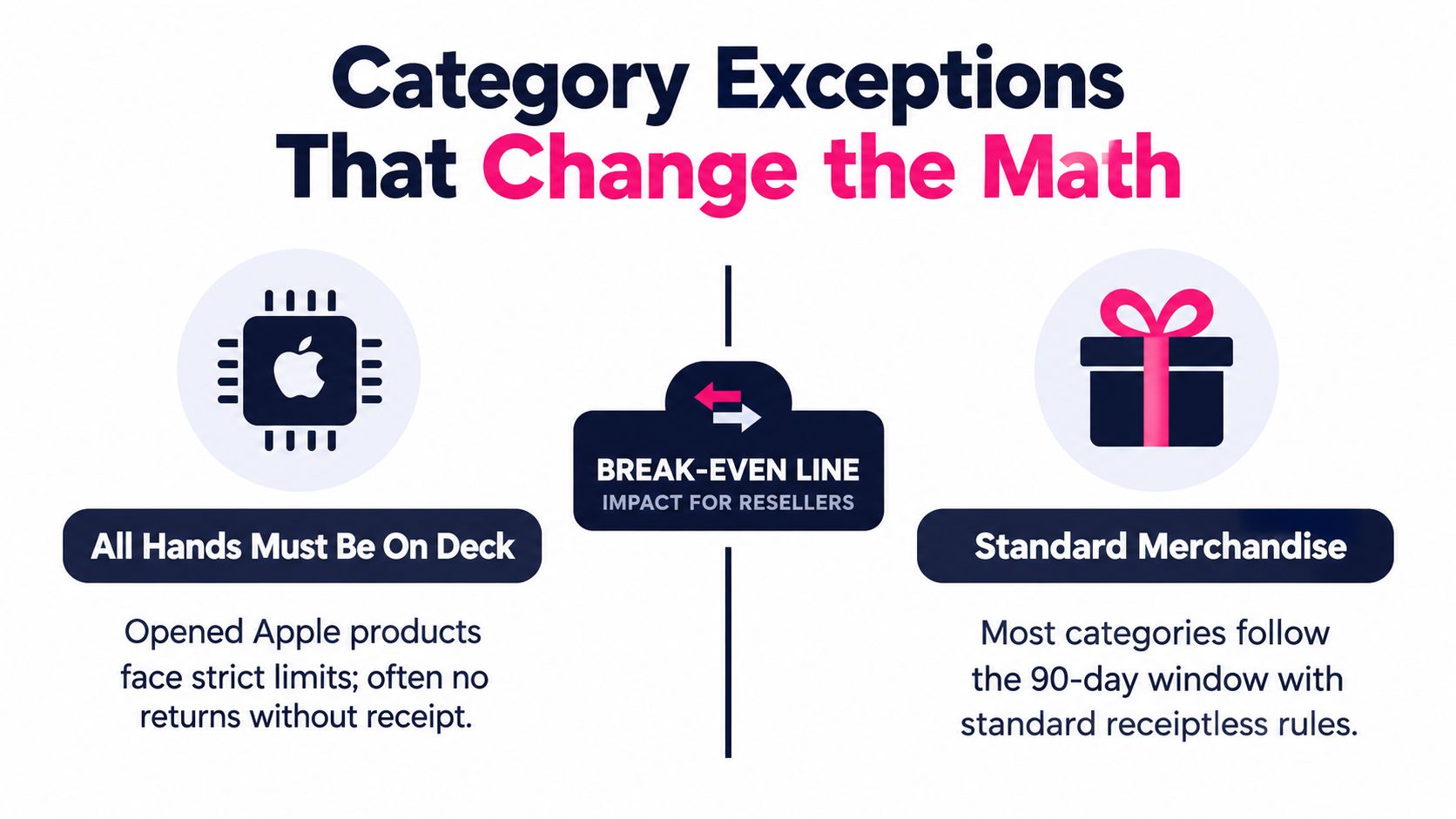
The math shifts quickly when an item moves from a 90-day opportunity to a 30-day decision. You have less time to test sold-through demand, wait for a better market, or correct a bad listing. For an opened electronics item, the possible return value may be zero, so the only sensible valuation is the resale exit after fees, shipping, condition risk, and expected holding time.
If the category is likely to be denied when opened, don't include Target as an exit in your buy calculation.
Gifts, Opened Items, and Merchandise Return Cards
A gift return without a receipt is not the same as a normal refund. The recipient may not need the giver's payment card or personal information, but the return still enters the store's verification and identity process. When Target accepts the return, the usual fallback is a merchandise return card rather than cash or a refund to the giver's original card.
The value can also differ from what the purchaser paid. For a no-receipt gift return, the system may use the current selling price attached to the barcode, rather than the original purchase price. That creates a difficult situation for resellers: a product bought during a promotion may return at a lower current value, while a scarce item may be assigned a different price than the one visible in old sold comps.
What happens at the desk
The item is scanned and inspected. The associate checks the barcode, category, condition, and available price information.
The recipient presents identification if required. The giver doesn't necessarily need to appear, but the recipient's return activity can still be recorded.
The system determines the value and method. If the item qualifies without proof of purchase, the result may be a merchandise return card based on the current verified price.
The card becomes the recovery asset. It can be useful for future Target purchases, but it isn't interchangeable with cash or a card refund.
Opened items follow the category rule, not personal assurances. General merchandise may be accepted when the policy permits opened returns, while opened cosmetics, certain electronics, and other restricted products may be denied. A sealed gift set is therefore materially safer than a tested or partially used one, even if both have identical sold comps.
The practical sourcing response is to save every digital receipt you can, connect purchases to the correct Target account, and retain the RedCard or payment-card trail. When you're deciding between two similar flips, use the guidance in how to price items for resale alongside the likely return method, not just the gross sale price.
A merchandise return card can still be useful when the verified value is close to your cost and you already shop at Target. It becomes a poor fallback when the value is reduced, the item has a narrow resale season, or the card forces you to buy merchandise you wouldn't otherwise source.
Sourcing Tips to Protect Your Flip Margin
The right decision happens at the shelf. Before you buy, separate three values:
- The resale value, based on sold comps and realistic sell-through.
- The verified-return value, based on whether Target can locate the purchase and whether the category qualifies.
- The no-proof recovery value, which may be a merchandise return card or nothing at all.
If your profit only works when the return is approved to the original payment method, the item is riskier than the scan suggests. If the product still works after a merchandise-card outcome, the return route can be part of the plan, but it should be a secondary recovery value rather than the reason you buy.
A shelf-level decision rule
At a Goodwill aisle, don't start with “Can I return this?” Start with “Would I still buy this if Target denied the return?” If the answer is no, the item needs a lower offer, stronger proof of purchase, or a pass.
At an estate sale, ask whether the seller has an order email, digital receipt, card statement, or account lookup. Don't confuse a retail sticker with proof of purchase. A Target clearance label can establish where the product came from, but it doesn't establish a valid return transaction.
At a garage sale, write down the SKU, condition, source date, and any available payment or order information. That record helps you decide whether to hold, sell, or pursue a return before the window closes. It also gives a future buyer more context if the item's retail history affects warranty or return expectations.
For the resale calculation, use sold prices rather than listing prices. Deduct marketplace fees, shipping, cost of goods, and the time cost of a possible return trip. A product with a thin apparent margin can turn negative after one failed return attempt, especially if it belongs to a category with strict condition rules.
ScanFlip AI fits at the sourcing stage because it offers AI photo scan with no barcode needed, barcode scan, and text search, then aggregates sold comps across eBay, Poshmark, Mercari, Depop, Amazon, Whatnot, ThredUp, Facebook Marketplace, and TikTok Shop. Its net-profit view accounts for fees and returns a red or green flip-or-pass verdict. Use that information with the return risk, not instead of it. Tools such as Vendoo and List Perfectly can support later marketplace workflows, but they don't change Target's verification decision.
Items worth passing on
Skip opened Apple products when the resale margin depends on a Target return. Be equally cautious with opened beauty, cosmetics, and gaming items. If the product has no proof of purchase and the only acceptable outcome is cash back to an original card, the receiptless route isn't a safety net.
Use the policy details and category exceptions in this retail arbitrage sourcing guide to build a repeatable shelf decision. The practical rule is simple: buy for the resale exit, price the return as a soft cost in COGS, and treat any verified refund as upside rather than guaranteed liquidity.
ScanFlip AI helps you make the buy decision before money leaves your pocket with photo identification, barcode scanning, text search, sold comps across major marketplaces, fee-adjusted net profit, and a red or green flip-or-pass verdict. Visit ScanFlip AI before your next Target clearance run, estate sale, or thrift-store sourcing trip, and check the return risk alongside the resale margin.