

Where Can I Sell My Clothes Online: 10 Best Marketplaces
You're standing in Goodwill with a $6 Ralph Lauren button-up in your hand. You're picturing a $30 flip, but the wrong channel, a shipping mistake, and an undisclosed defect could turn that plan into a $12 loss. Those are sourcing assumptions, not a sold comp, and that distinction matters before you buy.
The useful question isn't just “Where can I sell my clothes online?” It's where this particular shirt will sell at a price that covers your buy cost, fees, shipping, and work. A common striped button-up, a scarce vintage Polo piece, and a designer runway shirt don't belong in the same selling strategy.
Demand exists. 58% of U.S. consumers bought secondhand apparel in 2024, according to ThredUp's resale report coverage in Fashion Dive. That doesn't mean buyers want every mall-brand shirt in your cart.
- Match the garment: Check the exact label, fabric, measurements, condition, and recent sold comps.
- Match the economics: Compare take-home money, not the highest visible sold price.
- Match the work: Photographing, measuring, answering questions, and packing all count.
Clean photos help buyers assess what they're getting. The Visual Sandbox for product photos is an option for presentation work, but don't alter color, hide wear, or make a used garment look unworn.
The platforms below serve different jobs. Some are sourcing destinations. Others are better for clearing your closet without adding to your death pile.
Table of Contents
- 1. Poshmark
- 2. eBay
- 3. Mercari
- 4. Depop
- 5. Vinted
- 6. Grailed
- 7. Whatnot
- 8. ThredUp
- 9. The RealReal
- 10. Vestiaire Collective
- 10 Places to Sell Clothes Online at a Glance
- Pick the Channel Before the Money Leaves Your Pocket
1. Poshmark

Poshmark fits recognizable contemporary fashion, especially when buyers can shop your closet and bundle related pieces. Offers and bundles give you room to move inventory, but they also make it easy to discount away the margin you calculated at Goodwill.
According to Poshmark's FAQ, U.S. sales below $15 incur a $2.95 commission, while sales of $15 or more incur a 20% commission, with a prepaid label provided and the buyer normally paying shipping.
The blouse worth buying
Using the FAQ's fee structure, a hypothetical $6 blouse sold for $42 leaves $33.60 after commission and $27.60 after cost of goods, before packaging, tax, or seller-funded shipping discounts. That's the figure to compare against your required profit, not the gross sale.
At the rack, choose this channel when the style has identifiable demand and the condition supports the comp. Check cuffs, underarms, missing buttons, and fabric pulls before trusting the brand name.
- Works well: Contemporary brands, coordinated closet inventory, shoes, bags, and bundle-friendly pieces.
- Works poorly: Common basics that need heavy discounts to compete.
- Watch closely: Offers that combine a reduced price with a shipping concession.
I'd use Poshmark for the blouse with solid comps. I wouldn't buy a pile of ordinary blouses just because the label occasionally appears in a BOLO video.
2. eBay
A specific garment usually benefits from a specific search. Vintage workwear, discontinued outdoor clothing, unusual sizes, and identifiable sneaker models make more sense on eBay than an anonymous basic whose only selling point is being cheap.
Fixed-price listings let you wait for the right buyer. Auctions make more sense when you have evidence of competing demand, not when you're hoping bidding will rescue a weak purchase.
Weigh the packed garment
Consider this explicitly hypothetical budget: $5 cost of goods, a $35 sold comp, $5 reserved for selling charges, and $8 seller-paid shipping leave $17 before other expenses. The fee reserve isn't an eBay rate quote; replace it with the calculation for your account and category.
The danger is guessing postage. eBay's managed-shipping terms allow charges for underdeclared packages and explain that label prices depend on factors including weight and dimensions.
At a Ross clearance rack, assess the sweater in its eventual packaging, not just on the hanger. Heavy knits, denim, and shoes can change the buy decision.
Practical rule: If you can't estimate the packed shipment confidently, don't call the spread profit yet.
Use the guide to selling clothing on eBay to tighten your listing workflow. For garments requiring professional cleaning, review dry cleaning fees and HST explained and get a local quote before buying. Cleaning is part of cost of goods, not an expense to remember afterward.
3. Mercari

A $6 jacket on the clearance rack with $42 sold comps looks like easy money until the checkout math starts. Mercari suits sellers who already move household goods and electronics and want to add clothing without running a separate fashion operation. That convenience doesn't replace garment-specific sold comps.
Under the Mercari selling-fee policy, new or updated listings are charged 10% on the completed sale amount, meaning the item price plus buyer-paid shipping. Money collected from the buyer for postage isn't profit; it pays for the label.
Keep shipping out of your profit
Apply that to a $6 jacket listed at $42 with $8 buyer-paid shipping. The buyer's total checkout is $50, so the 10% fee comes to $5. Subtract $5 in fees, $8 for the postage label, and $6 cost of goods, and $31 remains before packaging and taxes.
That arithmetic matters at Goodwill. If your comp sheet counts the shipping collection as money you keep, you'll overpay for inventory at the register.
- Choose it for: Searchable everyday apparel with enough spread after transaction costs.
- Check first: The buyer's total checkout cost and who pays for the label.
- Pass on: Cheap garments whose margin depends on ignoring postage.
Mercari's return policy also makes return handling relevant, particularly for bulky apparel lots. Photograph flaws and describe fit with measurements rather than promises.
For a channel-by-channel decision, this Mercari versus eBay fee comparison lays out the math. Calculate the exact garment rather than assuming either marketplace always pays better.
4. Depop

A distinctive unbranded jacket can be more interesting than a familiar mall label. Depop is worth considering when silhouette, styling, vintage appeal, or subculture gives buyers a reason to care.
Under the stated U.S. policy, Depop doesn't charge a standard selling commission, but payment processing still applies, and optional boosted listings can add charges. No standard selling fee doesn't mean no selling costs.
Buy the style, verify the age
Suppose a garage-sale jacket costs $6, comparable pieces support $42, and you budget $2 for processing and $6 for seller-paid shipping. That hypothetical leaves $28 before packaging and taxes; the processing allowance is an assumption, not a quoted platform rate.
At the bin, inspect construction, tags, fabric, and alterations. Use the guide to identifying vintage clothing before describing something as vintage solely because it looks old.
- Strong fit: Distinctive denim, streetwear, unusual cuts, and pieces buyers can style around.
- Weak fit: Ordinary basics presented with vague trend keywords.
- Extra work: Styling, measurements, accurate color, and photos showing drape.
Don't buy a garment because you can imagine an excellent photograph. Buy it because comparable garments sell, then use photography to explain what makes yours desirable.
Aesthetic appeal can help discovery. It can't repair stretched elastic, remove permanent odors, or turn an oversaturated category into dependable inventory.
5. Vinted
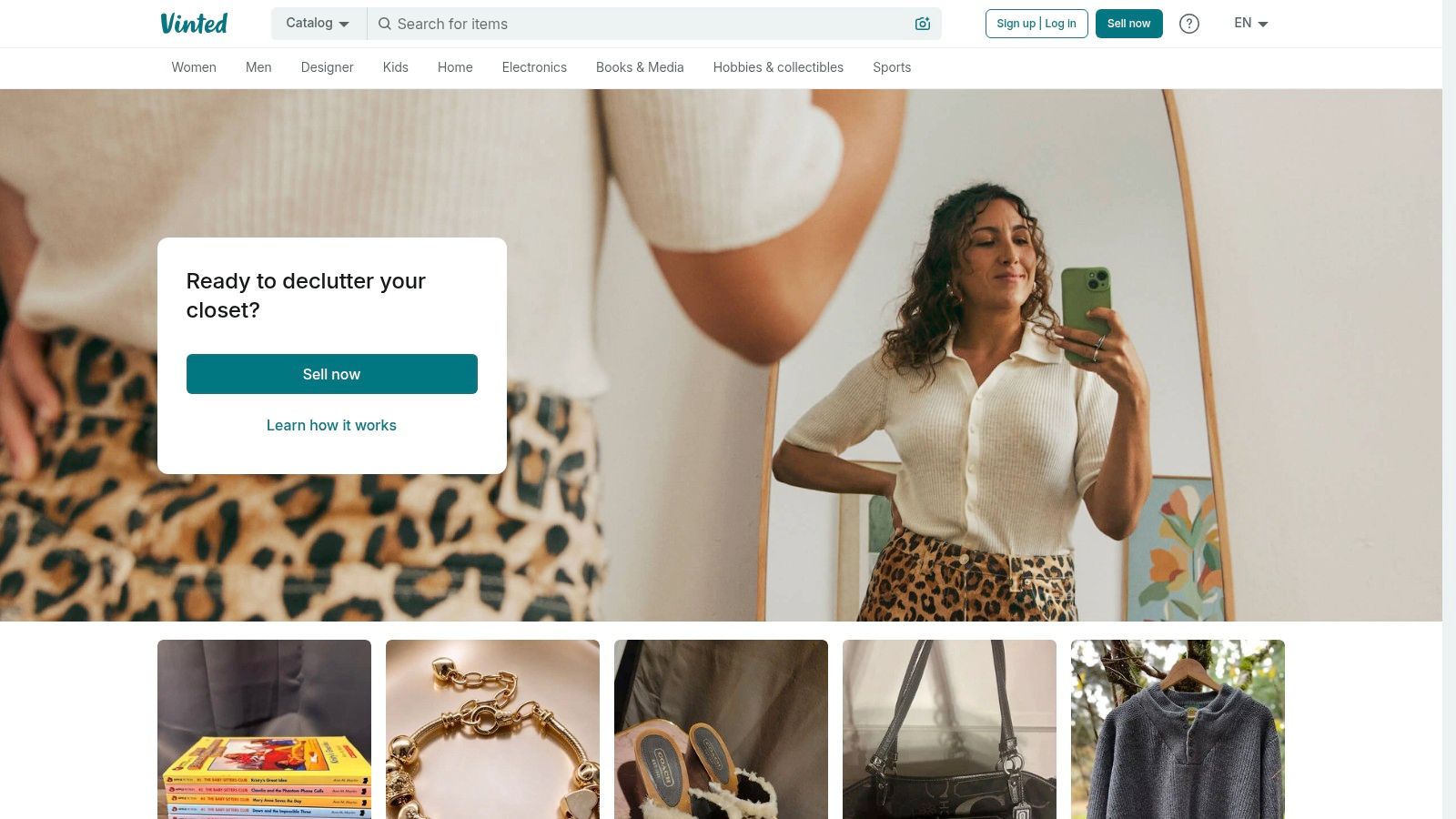
Vinted belongs on a closet-clearance list, not automatically on a professional sourcing list. Its standard U.S. accounts aren't intended for buying inventory to resell for profit.
Vinted's standard setup offers free seller listing and selling, with buyers covering shipping and paying a platform charge; optional visibility services can cost extra. Follow the supported shipping method so tracking and transaction protection work as intended.
Separate recovery from sourcing profit
For a hypothetical personally owned shirt, use $6 as its historical purchase cost and $30 as a supported sold-comp target. With no standard seller commission and buyer-paid shipping, that leaves $30 received, or $24 above the historical cost, before packaging or optional promotion.
That isn't permission to build a retail-arbitrage operation on a personal account. If you're standing at Nordstrom Rack buying specifically for resale, choose a marketplace whose account rules accommodate that activity.
A marketplace can have attractive fees and still be the wrong place for your business model.
Vinted makes more sense for wearable everyday clothing you already own, especially when you want straightforward transactions rather than a fashion storefront. Bundle compatible pieces where the transaction setup allows it, and avoid spending more on promotion than the garment can reasonably return.
The practical trade-off is control versus payout. You still photograph, describe, pack, and handle messages, even without a standard seller commission.
6. Grailed
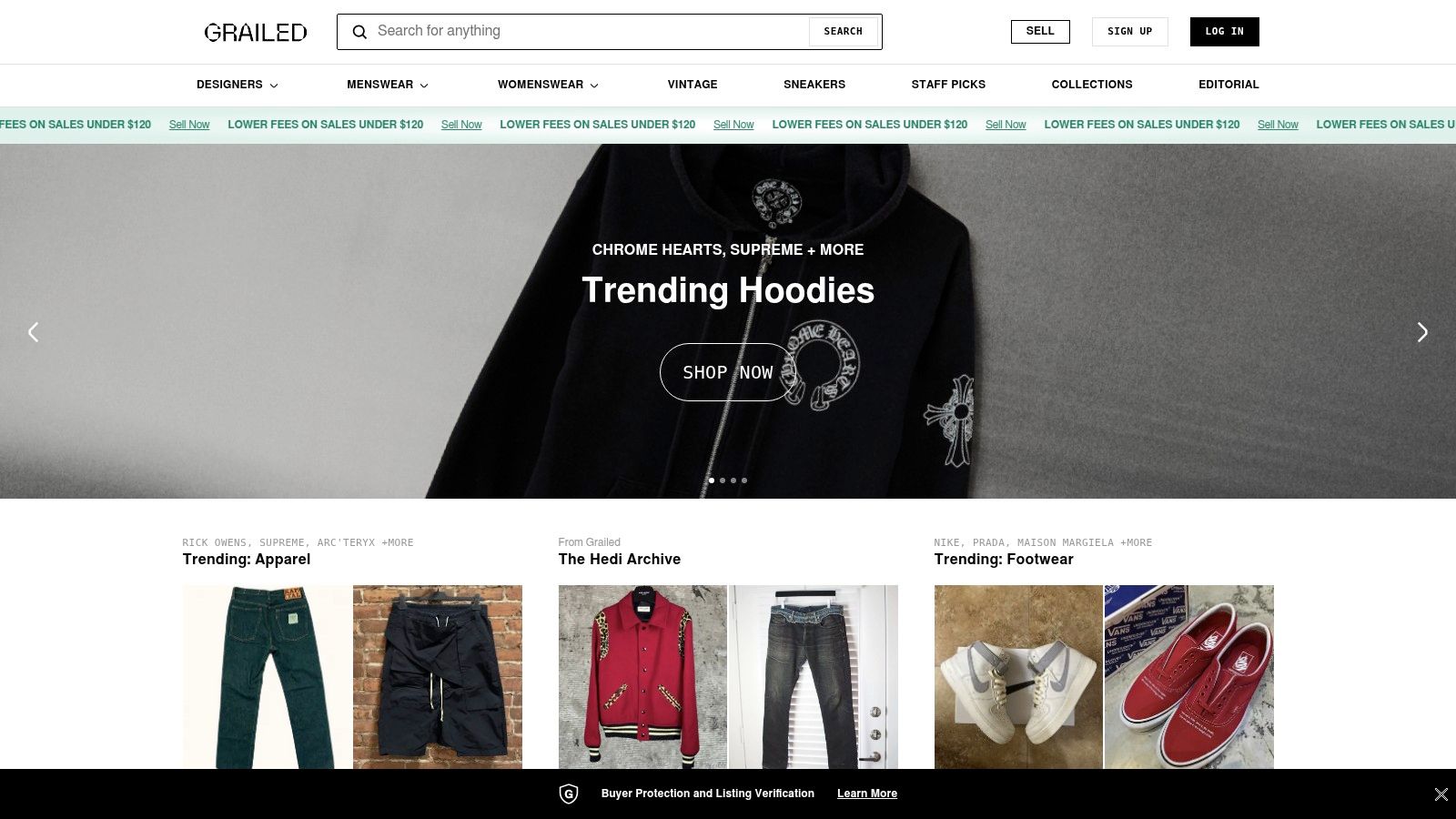
A designer menswear piece needs buyers who recognize the details. Grailed is a targeted option for menswear, streetwear, specialist labels, and harder-to-find fashion, rather than a destination for every shirt in an estate-sale closet.
The stated Grailed fee schedule charges 6% below $120, with a $1.99 minimum, and 9% at $120 or above, plus separate payment-processing charges. Check the applicable transaction terms before committing to inventory.
Know exactly which piece you found
Using that lower commission tier, a hypothetical $20 purchase sold for $100 incurs $6 commission. With assumed $4 processing and $8 seller-paid shipping, take-home after cost of goods is $62, before packaging and taxes.
The processing and postage figures are budgeting assumptions. They aren't universal Grailed charges.
At an estate sale, confirm the actual label, model, material, and condition before treating designer clothing as a BOLO. Similar-looking pieces from the same brand can have very different demand.
- Buy for specificity: Recognizable design details, desirable collaborations, or an identifiable specialist label.
- Document carefully: Alterations, measurements, wear, labels, and construction.
- Skip the shortcut: A designer name alone isn't evidence of strong sell-through.
I'd rather buy a clearly identified niche piece with defensible comps than a generic designer shirt with an impressive original retail price. Grailed's focused audience helps only when you've sourced something that audience wants.
7. Whatnot

Live selling changes the work. You're uploading a garment and waiting; you're preparing inventory, presenting condition, answering questions, and fulfilling orders after the show.
Whatnot offers live selling alongside non-live listings, with U.S. fashion commission starting at 8%, potentially decreasing through sales-volume tiers, plus payment-processing fees. Seller access requires applying or qualifying.
Don't build your buy around an optimistic auction
Using that starting commission, a hypothetical $6 shirt sold for $30 incurs $2.40 commission. Reserve an assumed $2 for processing, and with buyer-paid shipping, you have $19.60 after cost of goods, before supplies, taxes, and show labor.
That calculation only works if the shirt reaches the target. An eBay sold comp doesn't guarantee the same live-auction result.
At a garage sale, Whatnot may fit a coherent group of garments you can present to an existing audience. A random mixed lot is harder to sell efficiently when every piece needs a different buyer.
- Works when: You have relevant inventory, interested viewers, and a fulfillment routine.
- Costs time: Sorting, sequencing, measuring, broadcasting, and packing.
- Needs discipline: An opening bid you can afford to accept.
Auction guardrail: Set your sourcing ceiling from a conservative sale outcome, not the best result another seller achieved.
If you don't have the audience yet, searchable non-live listings may be the safer route for your strongest individual pieces.
8. ThredUp
ThredUp trades control for less listing work. You send eligible items through its Clean Out process, and the company handles inspection, photography, pricing, listing, and selling for accepted garments.
The ThredUp service doesn't promise every submitted item will be accepted or earn a payout. Earnings depend on eligibility and the eventual sale, while return assurance for unlisted items can add a cost where available.
Model the payout, not the customer's purchase
Here's a hypothetical consignment stress test, not a published payout schedule: a $6 garment sells for $30, but $24 goes to the service's share and allocated charges, with shipping assumed included in those charges. Your $6 payout leaves no profit after cost of goods.
That's why ThredUp can make sense for closet clearance but disappoint as a sourcing destination. A customer-facing sold price doesn't tell you what the consignor earned.
At an estate sale, don't buy ordinary apparel just because you can send it away instead of listing it. Check whether its expected payout justifies both acquisition and handling.
- Useful for: Eligible personal clothing you don't want to photograph individually.
- Less useful for: Inventory bought on thin margins.
- Confirm beforehand: Acceptance, payout eligibility, service charges, and what happens to unlisted items.
Not every wearable garment deserves an individual listing. Bundle low-value pieces where practical, or donate, recycle, or use a suitable textile take-back program when the handling work exceeds likely proceeds.
Clearing space is a valid goal. Call it clearance, not profitable flipping.
9. The RealReal
Authentication and specialist handling can matter more than a small difference in commission when you're holding eligible luxury. This option suits qualifying designer clothing and accessories, not ordinary closet basics.
The RealReal handles authentication, photography, pricing, and selling, with payouts varying by category, selling price, rewards tier, and payout choice. Qualifying cases can earn up to 85% or more of net selling price, but that ceiling isn't a forecast for your garment.
Stress-test the consignment offer
Suppose an estate-sale designer piece costs $20, relevant sold comps support $100, and your hypothetical consignment payout is $60 after a $40 retained share. Assuming no separate shipping charge in that example, you keep $40 after cost of goods, before taxes or other expenses.
Those amounts illustrate the decision, not a promised commission tier. Use the actual payout estimate and contract terms for the piece you're considering.
A premium label with damage, alterations, or weak demand may produce a disappointing result. Check acceptance before treating an estate-sale find as safely sellable through luxury consignment.
- Choose consignment for: Eligible pieces where authentication and reduced handling justify the retained share.
- Choose direct selling for: Pieces you can identify, describe, and sell confidently yourself.
- Pass when: Profit depends on receiving the best advertised payout.
The hands-off route still requires a careful buy decision. You're paying for service and access to buyers, not transferring every sourcing risk to the consignor.
10. Vestiaire Collective
Vestiaire Collective gives you a designer-focused international audience while leaving the listing work in your hands. It suits identifiable luxury clothing and accessories, especially when the likely buyer sits outside your local market. Expect a percentage selling fee plus a payment processing charge, and read the exact figures the platform quotes when you list, because fee schedules change.
Run the numbers before you commit
The math decides whether a designer find deserves a listing. Say a $20 designer purchase has sold comps supporting $100, and the fee quote shown when you list totals $15 across the selling fee and processing. Assuming buyer-paid shipping, you keep $65 after cost of goods. A prepaid label does not mean shipping costs disappeared; check how the platform allocates them before setting your price.
At a Nordstrom Rack clearance rack, identify the precise garment, match it to sold comps in comparable condition, and run the fee math on the spot before paying. The original retail tag is not proof of resale demand.
- Best candidates: Sought-after designer pieces with clear identifiers and convincing documentation.
- Required effort: Accurate measurements, detailed condition disclosure, and whatever checks the listing flow asks for.
- Poor candidates: Low-value basics or designer pieces you cannot verify.
International reach helps a niche garment find its buyer, and it adds transaction steps in exchange. Photograph labels, wear, and the packed item, then follow the platform's shipping instructions exactly.
I'd list here for a defensible designer find. If the profit only works when a buyer overlooks missing information, leave it on the rack.
10 Places to Sell Clothes Online at a Glance
Fee structure, audience, and workload differ enough that the same thrift find can take home meaningfully more on one platform than another. Sort the options by what each charges, what sells there, and how much work a listing demands.
| Platform | Seller Fees | Best For | Effort Level |
|---|---|---|---|
| Poshmark | $2.95 under $15; 20% for $15 or more | Contemporary clothing and accessories | Medium |
| eBay | Final value fee varies by category and sale price | Niche, vintage, collectible, or searchable items | High |
| Mercari | 10% selling fee on item price plus buyer-paid shipping; buyer protection fee may apply | Selling clothes alongside household items | Medium |
| Depop | No standard U.S. selling fee; payment processing and optional boosting fees apply | Vintage, streetwear, and distinctive fashion | High |
| Vinted | No standard seller fee; optional visibility features cost extra | Everyday secondhand clothing | Medium |
| Grailed | 6% under $120 ($1.99 minimum) or 9% at $120 or more, plus processing | Menswear, designer labels, and streetwear | Medium |
| Whatnot | Fashion commission starts at 8%, plus processing fees | Live apparel shows and auction-friendly items | High |
| ThredUp | Payout varies by item and eligibility; return assurance may cost extra | Clearing multiple eligible items with less listing work | Low |
| The RealReal | Variable commission; qualifying consignors may earn up to 85% or more of net selling price | Luxury designer clothing and accessories | Low |
| Vestiaire Collective | 12% for items $83–$16,667, or $10 below $83, plus 3% processing ($3 minimum) | Eligible designer pieces for an international audience | High |
Run the fee math on a realistic sale price before you commit. On a $50 sale, Poshmark keeps $10, Mercari takes $5 plus any applicable buyer-side fee, and Vinted charges the seller nothing. Effort is the other half of the equation. ThredUp and RealReal do the listing work but set the payout themselves, while Depop and Whatnot keep more of the sale price in exchange for photography, messaging, and live selling time.
Standing in the aisle, match the garment to the audience column. Searchable vintage and collectible pieces route toward eBay, trend-driven styling toward Depop, menswear toward Grailed, and verified designer finds toward the consignment rows.
Pick the Channel Before the Money Leaves Your Pocket
The channel decision happens at the rack, not after the garment joins your death pile. Before buying, name the likely buyer, the marketplace, the supported sold-comp range, and the costs between the sale and your bank account.
That also means separating ROI from worthwhile work. A cheap purchase can deliver an attractive percentage return while leaving too little actual money to justify measuring, photographing, messaging, and packing. Run the fee math on the channel you would use. Take an $8 blazer with a realistic sold comp of $45: on Poshmark, the 20% fee leaves $36, or about $28 after your buy cost. Listed on Mercari at the same price, the 10% fee leaves $40.50 before buy cost, and the buyer pays shipping. Same jacket, different take-home, decided before you pay.
Route by evidence, not brand recognition
Start with the garment itself. Check fabric, construction, size, seasonality, condition, and identifiers, then compare sold comps close enough to be useful.
- Brand: Route recognizable contemporary fashion toward a fashion-focused audience, and eligible luxury toward specialist channels.
- Price band: List individually when expected take-home supports the work; bundle or clear low-value basics.
- Niche: Send searchable vintage and discontinued pieces toward search-led buyers, distinctive styling toward visual discovery, and coherent live inventory toward an audience you can reach.
Sell-through rate matters alongside sold prices. Don't call something a BOLO because a seller once achieved a high sale; examine competing supply and whether comparable pieces keep selling.
For consignment, compare the customer-facing sold price with what reaches you after the service's retained share and applicable charges. Reviewing understanding consignment commission rates first keeps that comparison honest, since the payout percentage, not the listing price, decides whether consignment beats a direct sale.
Make the buy-or-pass decision first
ScanFlip AI offers AI photo scanning without a barcode, barcode scanning, and text search to identify a find and check sold comps across six major reselling platforms: eBay, Poshmark, Mercari, Depop, Amazon, and Whatnot. Its calculator accounts for buy cost, marketplace fees, and shipping, then returns a red/green flip-or-pass verdict against your profit threshold. I'd run anything borderline through it while standing in the aisle rather than trusting memory on what usually sells.
Use that estimate to challenge the purchase, not rationalize it. If the garment only works with the highest comp, no discount, perfect shipping, and no surprises, leave room in the cart for something better.
For your next death pile, sort by brand, realistic price band, and niche before opening any selling app. Give the strongest pieces their best channel, bundle the low-value wearable basics, and pull the garments that no longer justify more work.
Check your next rack find with an AI photo scan, barcode scan, or text search before paying for it. Visit ScanFlip AI to compare sold comps and estimate take-home profit after fees, shipping, and buy cost, then decide whether the garment belongs in your cart or back on the rack.