
Good Things to Resell on eBay: Proven Categories for Profit
A thrift find needs to sell for roughly 3x what you pay to have a realistic chance of clearing $15 in net profit after eBay fees and shipping. Good things to resell on eBay are usually identifiable, easy to test or describe, and supported by recent sold comps, not merely attractive in the aisle.
You're standing in Goodwill with a graphic tee in your hand. It looks cool, the brand seems familiar, and you remember selling something similar last month, so you drop it in the cart without checking the app. Two weeks later, it's still in the basement, and the only comparable sale you can find is $2.50.
That's how a death pile starts. The fix isn't finding a magical category. It's checking the buy price, sold prices, shipping burden, fees, condition, and likely return risk before your money leaves your pocket.
Table of Contents
- The Flipper's Aisle Rule
- Calculating Real Net Profit
- Top Profitable Categories for Flippers
- Scanning and Verifying Items Fast
- Sourcing Strategies for Maximum Return
- Avoiding the Vintage Trap
The Flipper's Aisle Rule
The first rule is simple: don't buy an item because it looks sellable. Buy it because the numbers leave room for a mistake.
A $6 shirt with recent sold comps around $42 can work. A $12 shirt with the same $42 resale value may not, especially if it needs washing, detailed measurements, stain treatment, or a return reserve. The brand alone doesn't make it a flip. The spread between your cost and the buyer's actual payment does.
Practical rule: If you can't identify the item, find a real sold comp, and estimate shipping while standing in the aisle, put it back.
The three-times rule is a fast filter, not a guarantee. A thrift find bought for $6 should generally have a plausible sold price near $18 or higher just to create room for fees and shipping. To target $15 net profit, a $6 purchase often needs a much stronger comp, such as $35 to $45, depending on the category and package size.
What the aisle test looks like
At a Goodwill rack, a random vintage-looking sweatshirt might have a $5 tag. The design catches your eye, but the tag is faded and the size is unclear. If similar pieces sell for $24, the item may fail once you subtract a fee, packing materials, shipping, and the time required to measure and photograph it.
A recognizable pair of athletic shoes is different. You can search the model, inspect the outsole, check the size, and compare condition against recent sales. The shoe may still be a pass if the soles are worn or the odor is strong, but at least the decision is based on evidence rather than nostalgia.
The same logic applies at a garage sale. A box of mixed cables looks cheap at $5, but generic cables are difficult to identify and often sell only when bundled. An exact OEM adapter with a model number can be worth buying, provided you can verify compatibility and test it.
Your buy decision needs a downside
Ask four questions before you commit:
- What is the realistic sold price? Use comparable brand, model, size, condition, and completeness.
- What will it cost to ship? A small accessory and a boxed appliance shouldn't use the same margin rule.
- What can go wrong? Hidden defects, authenticity concerns, missing parts, and returns matter.
- Will I list it soon? A profitable item that sits unlisted becomes part of the death pile.
eBay's scale creates opportunity, but it also creates competition. eBay reported nearly $80 billion in global GMV, 135 million active buyers, and approximately 2.5 billion live listings in 2025 in its annual filing. That volume favors items buyers can search precisely, such as a trading card set, sneaker model, replacement remote, or part number.
Calculating Real Net Profit
Gross revenue is a vanity number. Net profit is what remains after cost of goods, marketplace fees, shipping, packing, and the costs you can reasonably anticipate.
eBay states that final-value fees vary by category from 2.5% to 15.3%, with a per-order fee of $0.30 for orders of $10 or less and $0.40 above $10. The fee calculation generally includes the item price and shipping, so pricing from the headline sold price alone can overstate the money you'll keep. See eBay's seller fee guidance before setting category-specific assumptions.
Here's a practical example. You buy a branded jacket for $6 and sell it for $42. Assume the fee is $5.60, shipping costs $4.50, and packing costs $0.50.
| Transaction item | Amount |
|---|---|
| Sold price | $42.00 |
| Cost of goods | -$6.00 |
| eBay fee | -$5.60 |
| Shipping | -$4.50 |
| Packing materials | -$0.50 |
| Net profit | $25.40 |
If you leave out packing, the calculation produces $25.90, but that's not the complete result. Small costs matter, particularly when you sell low-ticket goods or buy supplies specifically for a difficult shipment.
Use the buyer's total transaction
Fees can apply to the item price and shipping, so a “free shipping” offer doesn't eliminate the expense. It only changes where the buyer sees it. For example, selling an item for $35 with $7 shipping and selling it for $42 with free shipping can produce different fee and shipping outcomes even though the buyer's total is similar.
Returns also belong in your decision. You don't need to invent a return percentage, but you should recognize the risk. Clothing with vague measurements, electronics described as “untested,” and collectibles with uncertain authenticity can consume profit through refunds, two-way shipping, or labor.
A useful purchase formula is:
Expected sold price minus fees, shipping, packing, cost of goods, and risk allowance equals expected net profit.
If that result doesn't clear your minimum, pass. The exact threshold depends on your workflow, but this article uses $15 net profit as the floor. A $4 book that nets $8 may be useful for a high-volume scanner, but it isn't the same buy as a $4 accessory that nets $22.
For a deeper breakdown of the calculation, use this net profit guide for resellers. The important habit is checking the math before purchase, not rationalizing the buy afterward.
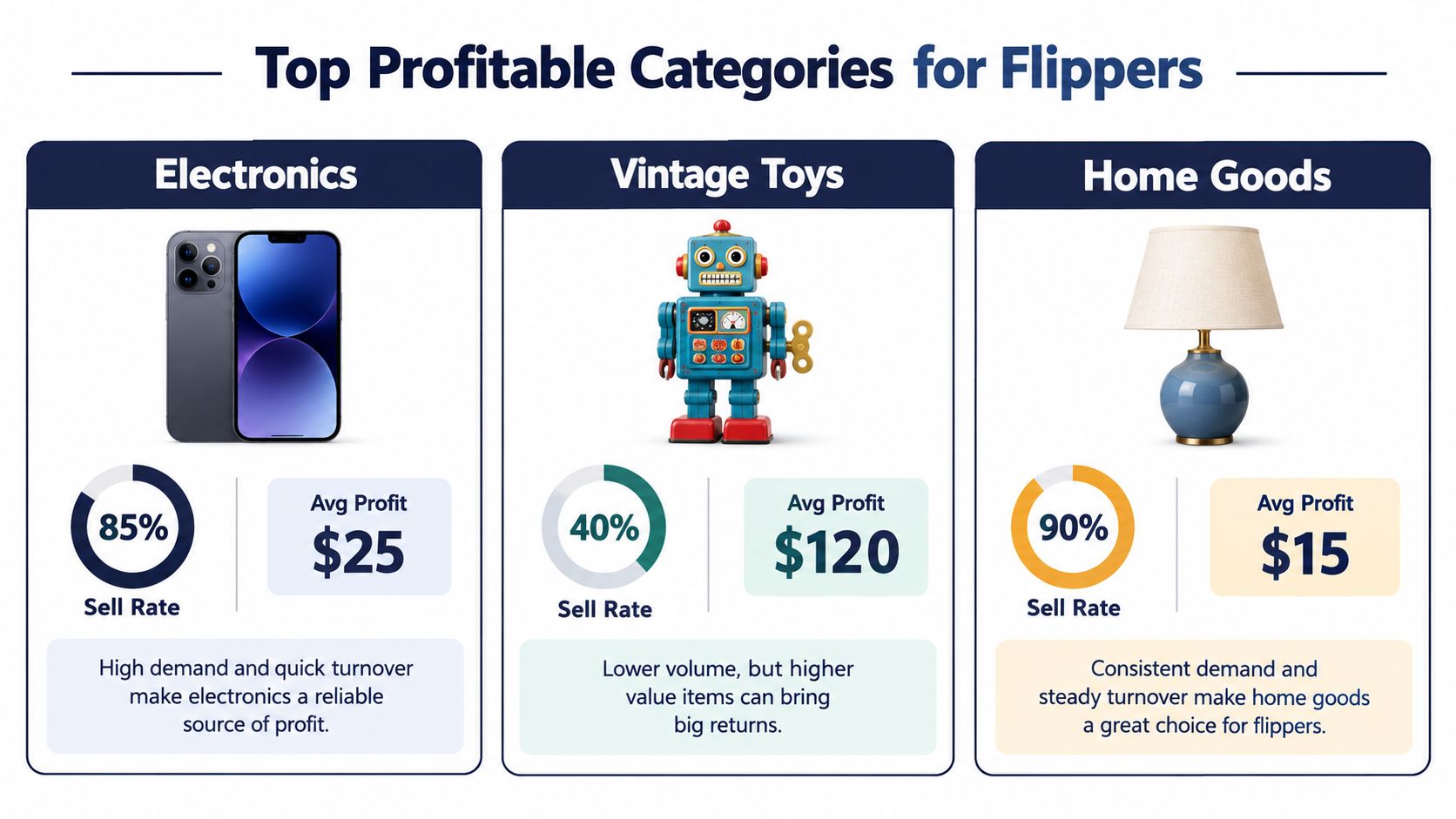
Top Profitable Categories for Flippers
A category can show strong sales and still produce a weak flip. The useful test is whether the individual item clears the $15 net profit floor after fees, shipping, packing, purchase cost, and likely problems. Apparel, collectibles, and electronics accessories can pass that test, but each has a different way to lose money.
Sneakers and athletic apparel
Secondhand apparel remains a useful sourcing category. The U.S. secondhand apparel market grew 14% in 2024, while online resale grew 23%, according to ThredUp's 2025 Resale Report. Branded sneakers, technical outerwear, sportswear, and recognizable vintage pieces benefit from buyers searching for exact models.
At a thrift store, check the model name, size, soles, and overall condition before buying. A pair purchased for $18 and sold for $70 might clear the $15 floor after fees and shipping. The same sale price on a $35 purchase may fail once authentication, cleaning, or a missing insole takes its share.
Athletic apparel usually ships more easily than equipment, but fit-related returns can erase the margin. Measure the waist, inseam, chest, and sleeve length where relevant. Photograph stains, pulls, sole wear, heel drag, and damaged tags clearly.
Collectibles and trading cards
Collectibles have uneven margins because edition, condition, completeness, and authenticity can change the value sharply. A common-looking toy may be worthless without one accessory, while the correct variant can clear the threshold comfortably.
Record the set, release year, manufacturer, catalog number, edition, serial number, and visible defects. For cards, inspect centering, corners, edges, surface, print defects, and grading status. Match sold comps to the exact version. Grouping different cards because they share a player or franchise is a reliable way to overpay.
eBay includes Collectibles & Memorabilia among its seller categories in its recommerce reporting. That indicates marketplace activity, not guaranteed profit. A $3 card selling for $8 can lose its margin to the per-order fee and protective packaging. A correctly identified $3 card selling for $35 has a much better chance of clearing the floor.
Used electronics accessories
Small accessories often make cleaner flips than large electronics. Chargers, adapters, cables, remotes, cases, and replacement components have clear buyer problems, standardized identifiers, and manageable package sizes.
Find the manufacturer part number and compatibility details. Test voltage output, connector integrity, battery health, and proprietary components. A genuine laptop charger bought for $4 and sold for $28 may outperform an untested stereo bought for $20, even when the stereo has the higher possible sale price.
Use this guide to profitable resale items for category research, then verify the exact unit and run the net-profit calculation. The decision belongs to the item, not the category label. A promising comp is only a pass when the final numbers clear $15.
Scanning and Verifying Items Fast
At a garage sale, speed matters. There may be a box of old electronics parts, three buyers behind you, and a seller who doesn't know whether the adapter is valuable. You need an answer before someone else picks it up or the seller names a price.
Start with identification. Find a barcode, model number, brand tag, set name, or distinctive physical feature. Don't search broad terms such as “old charger” or “vintage toy.” Search the exact identifier whenever possible because broad results mix incompatible products and distort sold comps.
A fast verification workflow
- Identify the item. Use the barcode if the product is boxed and labeled. For untagged shoes, apparel, electronics, or collectibles, use a clear photo. If the item can't be photographed cleanly, search its name or model number with text.
- Check sold comps. Look at recent completed sales, not active listings. Match condition, accessories, colorway, edition, size, and completeness.
- Run the net calculation. Enter your purchase cost, expected shipping, likely fees, and your $15 minimum. If the result is below the threshold, pass unless you have a specific reason to accept lower profit.
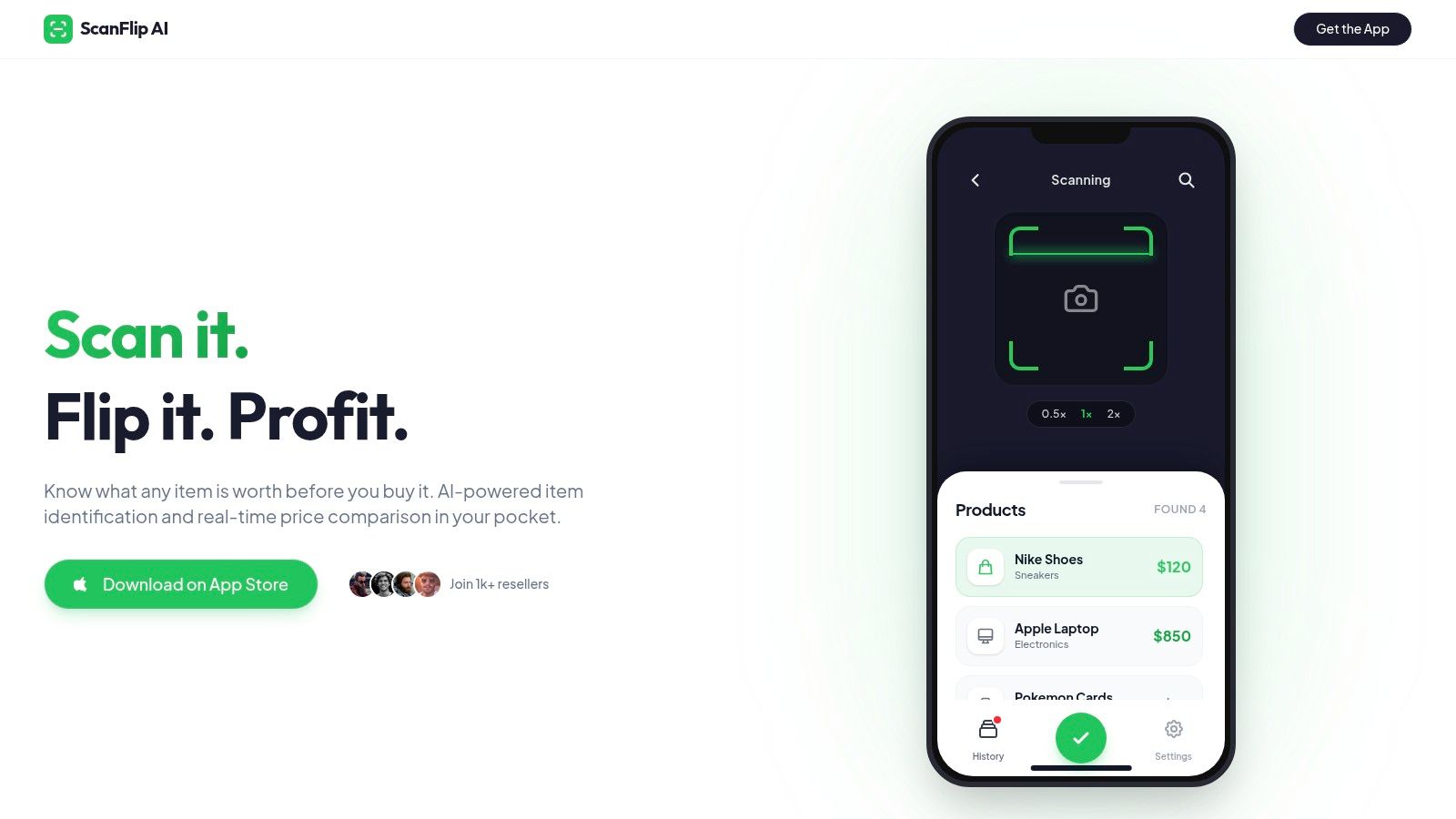
ScanFlip AI offers three ways to scan, AI photo scan with no barcode needed, barcode scan, and text search. It pulls sold comps from eBay, Poshmark, Mercari, Depop, Amazon, Whatnot, ThredUp, Facebook Marketplace, and TikTok Shop, then estimates net profit after fees and shipping with a red or green flip-or-pass verdict. It's a sourcing tool, not a listing, crosslisting, inventory management, or bookkeeping system.
Interpret the result, then inspect the item
A green verdict doesn't override physical condition. If the shoes have sole separation, the card has a crease, or the charger fails testing, the comp no longer describes your unit. Change the condition, expected price, or cost inputs and run the decision again.
A red verdict also deserves a quick sanity check. The scan may have identified the wrong variant, or the seller may have priced a rare version like a common one. Confirm the model number and exact edition before walking away.
For retail arbitrage at Ross or TJ Maxx, barcode scanning is efficient for boxed goods, games, media, and accessories. For vintage clothing at an estate sale, photo identification and text search are more useful. The retail arbitrage scanning guide covers the workflow, but the rule remains the same: identify first, compare sold prices second, calculate net third.
Sourcing Strategies for Maximum Return
The best sourcing location depends on the kind of uncertainty you can handle. Goodwill offers volume but often requires sorting. Estate sales offer better context and older inventory, but prices can be higher. Ross and Nordstrom Rack provide clean, new products, yet other arbitrage sellers may be checking the same clearance racks.
At a thrift store, start with items that have searchable signals. A Nike model tag, a Carhartt style label, a Levi's lot number, a sneaker tongue label, or an OEM electronics part number gives you something concrete to research. A generic black hoodie gives you almost nothing besides condition and size.

Match the source to the inventory
Goodwill and the bins work well for apparel, shoes, books, media, and small electronics. At the bins, weigh the labor against the purchase advantage. A cheap item that takes twenty minutes to identify, clean, photograph, and pack may be worse than a higher-priced item you can list immediately.
Garage and estate sales are useful for collectibles, tools, cameras, media, replacement parts, and older household electronics. Dig through drawers, unopened boxes, and accessory bins. Sellers often price a complete lot as clutter, while buyers search for one exact component.
Ross, TJ Maxx, and Nordstrom Rack are better for new branded apparel, shoes, bags, beauty products, and seasonal clearance. Check the SKU, size distribution, packaging, expiration information where relevant, and current sold comps. A clearance sticker is not a profit signal. It only tells you the store wants the item gone.
Look for searchable scarcity
A BOLO isn't just an item other sellers mention. It's an item with a combination of recognizable identity, recent sold demand, limited local supply, and acceptable risk.
Examples include an OEM replacement part, a discontinued sneaker colorway, a complete vintage toy, a specific trading card variant, or a sealed accessory compatible with an older device. These items solve a buyer's exact problem. Generic goods compete mainly on price.
Use a simple buy threshold at the source. If the expected net is $15 or more after realistic costs, the item qualifies for deeper inspection. If it misses, ask whether the price can be negotiated, whether bundling improves the economics, or whether you're just trying to rescue a weak buy.
The cheapest inventory isn't always the best inventory. Cheap items create a profit only when buyers can find them and you can process them quickly.
Shipping should shape your route. Compact accessories, cards, media, and apparel are easier to store and ship than oversized home goods. Bulky items may have strong gross prices, but dimensional weight, damage, local-pickup limitations, and storage space can erase the advantage.
Avoiding the Vintage Trap
“Vintage” describes age or style. It does not guarantee value.
The pre-owned fashion market has active buyers. Nearly 40% of clothing, shoes, and accessories sold on eBay were pre-owned in early 2025, and global users searched for “vintage” more than 1,200 times per minute, according to Fashion Dive's report on eBay's watchlist trends. Those figures show interest in the category, not profit on every jacket or shirt.
A faded graphic tee with no readable tag may look appealing and still fail the flip-or-pass test. Work pants with a clear brand, model, waist, inseam, and recent sold comps may produce the stronger buy. Run both through your net-profit calculation, including fees, shipping, cleaning, and your time.
Separate aesthetic appeal from demand
Check the details buyers search for:
- Brand and model: A recognizable label helps, but the exact line, era, and model still affect demand.
- Measurements: Vintage sizing varies. Shoulder width, chest, length, waist, and inseam help buyers judge fit and reduce avoidable returns.
- Material and construction: Leather, selvedge denim, technical fabric, single-stitch construction, and distinctive labels can narrow competition.
- Condition: Odor, stains, repairs, missing buttons, dry rot, cracking prints, and altered hems can reduce price or make the item a pass.
- Season and timing: A heavy coat may sell later, but slow inventory ties up cash and storage space.
Pre-loved clothing has a broad customer base. 58% of U.S. consumers said they purchased secondhand apparel in 2024, while Gen Z and Millennials reported plans to allocate nearly 46% of their apparel budgets to secondhand goods during the following 12 months. Those figures support the category, not every vintage item inside it.
A low purchase price does not rescue weak demand. Add cleaning, measurements, repairs, authentication, photography, packing, and expected selling fees before calling an item a bargain.
The strongest vintage niche is usually narrower than “vintage clothing.” It might be a specific workwear brand, sportswear line, music-related garment, hard-to-find size, or imperfect piece with a clearly disclosed flaw. Compare exact sold comps, set a minimum net profit of $15, and leave the rack when the numbers miss.
ScanFlip AI helps evaluate that decision at a thrift rack, garage sale, or clearance aisle through AI photo scanning, barcode scanning, and text search. It compares sold comps across major marketplaces, estimates net profit after fees and shipping, and returns a red or green flip-or-pass verdict. Visit ScanFlip AI before sourcing to keep weak buys out of your death pile.