


Machine Learning for Pricing Resellers Can Use
You're standing in a thrift aisle with a vintage jacket in your hand, the tag says $14.99, and the sold comps on your phone look promising. The problem is never just the sold price. It's whether that jacket still clears your net profit after marketplace fees, shipping, returns, and the cost of buying it before someone else does.
That's where machine learning for pricing matters to resellers. The useful version isn't some abstract prediction of “value,” it's a buy-or-pass decision that blends sold comps, condition, seasonality, fees, and demand into one fast read. The better the model, the less often you get fooled by a high asking price, stale comps, or a category that looks hot but won't leave enough margin after costs.
Table of Contents
- The Buy Decision Behind Every Price
- Core Pricing Concepts Every Reseller Should Know
- Models and Features That Shape Resale Prices
- Data Quality and Pricing Metrics
- Building and Maintaining a Pricing System
- Fast In-Aisle Pricing for Resellers
- Operational Risks and Ethical Boundaries
- A Reseller Workflow That Ends With a Good Decision
The Buy Decision Behind Every Price
A lot of bad buys start with the wrong number. An asking price on eBay, a sticker on a shelf, or a stale comp from six months ago can make an item look better than it really is. In the aisle, the number that matters is the one that still works after fees, shipping, and your minimum profit threshold.
Why sold comps beat sticker shock
A jacket tagged at $14.99 can still be a strong buy if recent sold prices leave enough room for profit. The same jacket can be a pass if the comps are thin, the size is awkward, or the marketplace fees eat the spread. Resellers trust sold comps more than listed prices because sold comps show what buyers paid, not what sellers hoped to get.
Practical rule: if the item cannot clear your minimum after fees and shipping, it is not a flip. It is inventory with a story.
Machine learning for pricing helps because it does not ask you to rely on one signal at a time. Pricing systems built on large data sets can weigh historical sales, competitor prices, seasonality, inventory, and promotions together, and they work best when they are monitored over time instead of treated as a one-time guess. McKinsey's overview of pricing analytics makes that multi-signal approach clear, and it explains why model-driven pricing replaced older rule-based markup thinking in data-rich categories McKinsey on machine-learning pricing performance.
For resellers, the key question is not a broad estimate of value. It is whether the item has a good chance of clearing your buy threshold after cost of goods, marketplace fees, shipping, and likely returns are included. That is a harder question, but it is the one that protects cash in a Goodwill aisle, a garage sale bin, or an estate sale basement.
The catch is that a model can be right and still be useless if the market changes before you list the item. Thin-margin categories leave little room for delay, and long-tail items can look attractive on paper while sitting too long to matter. A dependable buy signal has to survive that gap between estimate and exit, because the reseller is committing money before the sale is real.
Core Pricing Concepts Every Reseller Should Know
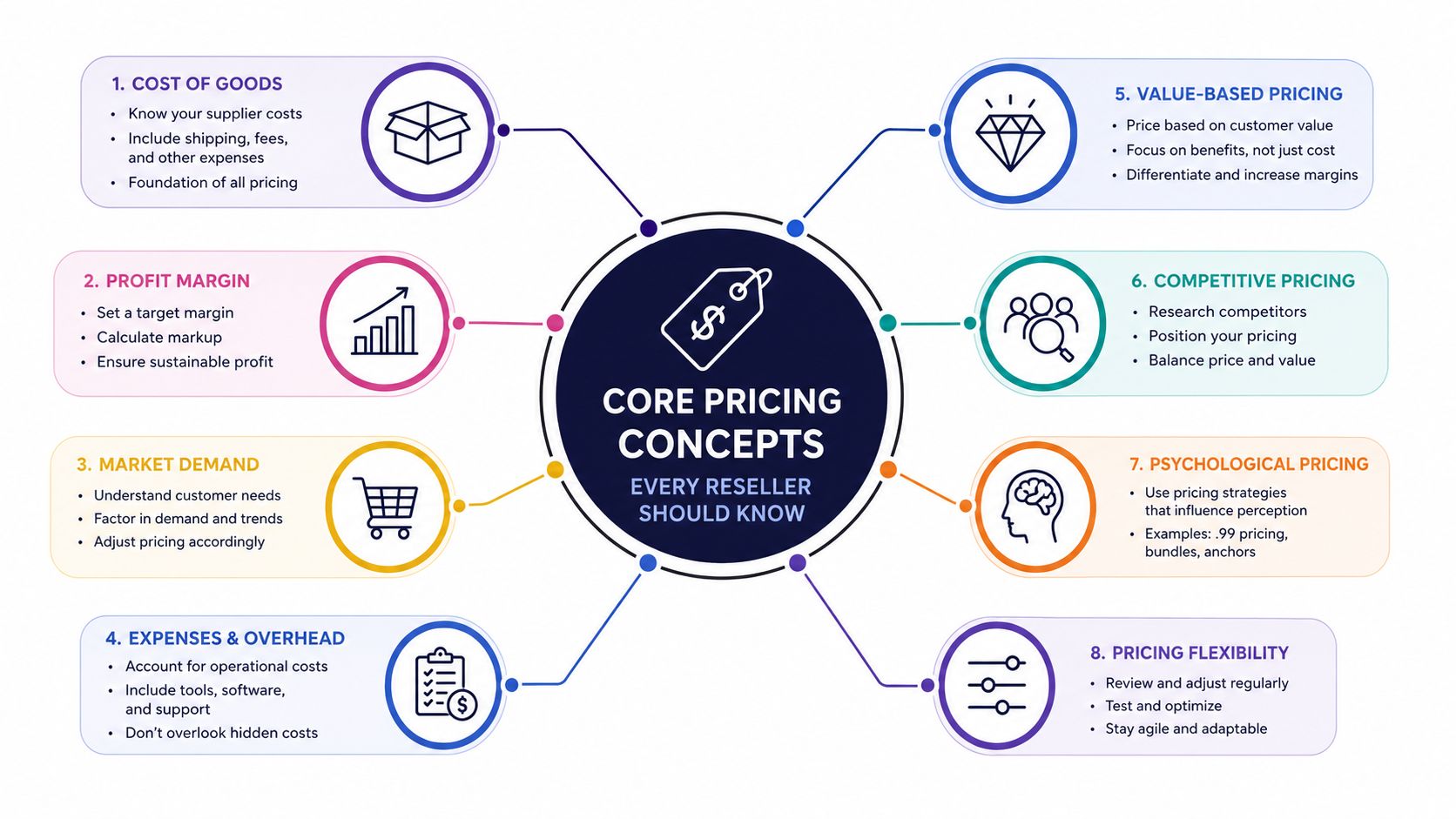
A reseller standing in the aisle needs a fast read on more than list price. The useful version blends demand forecasting, condition, seasonality, fees, and likely exit speed into one decision about whether the item clears a personal profit floor.
Demand forecasting starts the process. In resale, it means estimating how much buyer interest an item is likely to draw, not chasing a single theoretical value. A vintage jacket, a men's blazer, and a niche collectible can share a similar headline price in one setting and still face very different demand because size, season, and platform all change the result.
Price response is the part most sellers skip
Price elasticity is the next idea, and it matters at the point of purchase. If the buy price moves up a little, does the expected sale still clear your threshold after cost of goods, marketplace fees, shipping, and returns? If the listing price has to come down later, does demand rise enough to make the margin worth the trouble?
A better model is a price-response model, not just a resale-value estimate. It looks at the probability of sale at different price points, then chooses the price or buy decision that fits the objective. Wipro describes this in B2B pricing as modeling bid price against win probability with an S-shaped response curve, which maps well to a reseller deciding whether to buy before someone else grabs the item Wipro on machine learning for B2B pricing.
Dynamic pricing sounds fancy, but the reseller version is practical. You do not need to change prices every day to use it well. You need a process that can adjust when the evidence changes, such as softer seasonal demand, a fee change, or fresh sold comps that weaken the case.
A vintage concert tee with a recent sold-comps range can look attractive, but the expected outcome changes fast if the shirt is faded, the print is cracked, or the marketplace shifts. Thin-margin sourcing leaves little room for a stale assumption, and long-tail items can sit long enough for a decent estimate to turn into a weak buy. A profit-minded model folds those realities together instead of pretending all tees are equal.
Forecast first, elasticity second, profit third. If the model cannot connect those three, it is only giving you a prettier guess.
Models and Features That Shape Resale Prices
A pricing model only helps if it reflects how a buy decision really works on the resale side. You are not just trying to predict a future sticker price. You are deciding whether the expected net profit clears your threshold after cost of goods, marketplace fees, and shipping are taken out. A model can look polished and still miss the moment that matters, which is the checkout decision in the aisle.
A simple regression can work when comps are clean and the category behaves predictably. Decision trees are often a better fit when the relationship is not linear, because they can split on resale details like brand, condition, and marketplace. Neural networks can help when interactions are messy, but they demand more care, more data, and more discipline than most casual sellers have time for.
The data points that matter
For a reseller, the features should look familiar. Start with item identity, brand, category, age or release details, condition, seasonality, marketplace, recent sold comps, fees, shipping, and your own cost of goods. If you are scanning a pair of shoes, size and condition may matter more than they do for a book. If you are pricing a collectible, sparse comps and category quirks may matter more than a neat historical average.
The strongest pricing systems do not treat every item the same. A mainstream book with plenty of sold comps is usually easier to estimate than a niche toy with only a few comparable sales and an odd release history. That is why an impressive-looking number is weak if the features do not match the item sitting in your cart.
Machine learning for pricing works because it can combine many factors at once. McKinsey describes pricing systems that rely on large data sets and ongoing monitoring, which is useful in resale because the model has to keep up with changing comps, fees, and demand patterns. In pricing optimization work, systems can model many demand and non-demand factors together instead of relying on one rigid rule. That is the difference between “I saw one good comp” and “I understand why this item should sell in this range” McKinsey on machine-learning pricing performance.
Recent sold comps are only part of the picture. In a thin category, the model has to rely more on condition, brand strength, and timing because history is sparse. In a thicker category, it can be more confident because there are more transactions to anchor the estimate.
For a practical look at demand inputs, use this guide to market demand forecasting as a companion to the ideas here. It pairs well with reseller pricing because it is easier to judge a buy when you know whether demand is steady, seasonal, or fading.
The right model does not just answer “what did it sell for?” It answers “what changes the sale price, the sale probability, and the net profit after fees?”
Data Quality and Pricing Metrics
A pricing estimate is only as good as the history behind it. If the comps are stale, the item is misidentified, or the condition labels are sloppy, the model can look precise while still being wrong. That is a real problem at the register or in the aisle, because a clean-looking number can push you into a buy that never clears your threshold.
Clean inputs matter more than fancy math
You want sold-comps history, timestamps, clear item IDs, marketplace context, realized fees, shipping costs, and outcome data that shows what actually closed. A sale that really happened is worth more than a listing that got views, likes, or watchers. In the aisle, attention does not pay your bills.
The best way to judge a pricing model is to separate technical accuracy from business usefulness. Error measures tell you how far the estimate is from the observed sold price. Calibration tells you whether the confidence is believable. But the reseller still needs business metrics like net profit, margin, sell-through rate, and time to sale, because a model can be “accurate” and still fail to produce a worthwhile flip.
Here is the point that matters at purchase time. If you buy a hoodie for a known cost, then sell it on a platform with fees and shipping, the model needs to estimate whether the final take-home clears your threshold. The gross sold price might look fine, but a few extra dollars in fees can erase the deal.
| Pricing Metric | What It Measures | Reseller Decision |
|---|---|---|
| Error against sold price | How close the estimate is to the actual sold comp | Trust the estimate or discount it |
| Calibration | Whether the confidence matches reality | Treat the result as dependable or uncertain |
| Net profit | Take-home after fees, shipping, and cost of goods | Buy or pass |
| Margin | Profit relative to cost | Decide if the item fits your threshold |
| Sell-through rate | How often similar items move | Avoid dead inventory |
| Time to sale | How long items sit before selling | Judge whether cash is tied up too long |
For a clean example database approach, this comparable sales guide is a useful companion. In thin or messy data, confidence should go down, not get dressed up by a tidy-looking score.
Building and Maintaining a Pricing System
The first decision isn't the model, it's the question you want answered. For a reseller, that's usually, “Should I buy this item at this cost right now?” If the system can't answer that cleanly, everything else is decoration.
Start with the history you can trust
Build the dataset from recent sold comps, your buying costs, fees, shipping, and final outcomes. Then test a basic model before jumping to something more complex. In practice, a simple baseline often tells you whether the category is predictable enough to deserve more work.
The next step is backtesting against past sales. That means using earlier data to predict later outcomes, which is far more honest than training on the same sales you're trying to judge. After that, roll the model out in a controlled way and record the predictions next to the actual outcomes so you can see where it's helping and where it's missing.
A workable pricing system also has to watch for drift. Categories change. Seasonal demand changes. Marketplace fees change. Sparse categories get even harder to estimate when the sales history dries up or when a few odd comps start dominating the picture.
Good practice: if the model keeps missing in one niche, don't force confidence into it. Separate that category and review it manually until the market makes sense again.
Here's the part people skip. A pricing system is not “done” after it gets trained. It needs recalibration when comps go stale or the market regime changes, especially in volatile or long-tail categories. That's the whole point of using machine learning for pricing, it can be updated as new data arrives instead of freezing the market in place.
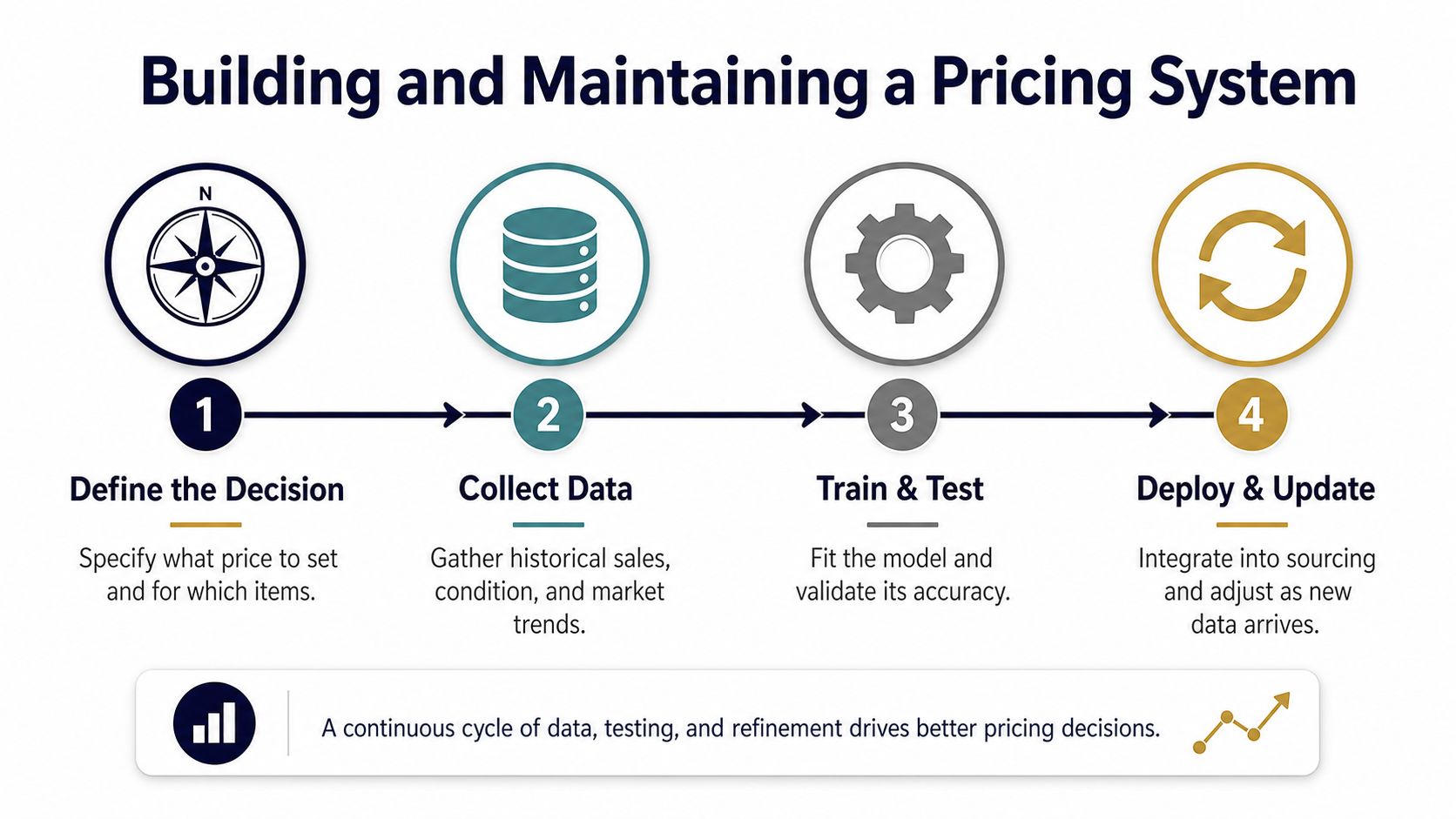
The best systems keep a log of what they predicted, what sold, and which buys turned into dead stock. That gives you a real feedback loop instead of a pile of confident guesses.
Fast In-Aisle Pricing for Resellers
Thrift stores, estate sales, garage sales, and retail arbitrage all share one constraint, you have seconds to decide. The model only matters if it helps you answer the buy question before someone else takes the item, and before you commit cash to inventory that may not move.
A sourcing tool has to answer the buy question
A good in-aisle workflow identifies the item, pulls recent sold comps, subtracts marketplace fees and shipping, and shows expected net profit against your minimum. That is the reseller question in plain terms. The item might have a strong resale story, but the buy decision depends on whether the margin still works after every deduction.
ScanFlip AI fits that sourcing moment. It uses three scan methods, AI photo scan with no barcode needed, barcode scan, and text search. It also pulls sold comps across eBay, Poshmark, Mercari, Depop, Amazon, Whatnot, ThredUp, Facebook Marketplace, and TikTok Shop, then shows a red or green flip-or-pass verdict based on net profit after fees and shipping. If you already use tools like Vendoo, List Perfectly, or Crosslist, this sits earlier in the process, at the buy decision, not the listing workflow. ScanFlip AI
That matters because a reseller standing in a Goodwill aisle does not need a long dashboard. They need a quick read on whether the item belongs in the cart or should stay on the shelf. Faster research reduces the chance of losing good inventory while comps are being checked app by app.

When the item has a barcode, a scan gets you there quickly. When it does not, photo identification matters more, especially for shoes, vintage clothing, collectibles, and oddball electronics. When the item is hard to photograph or the name is known, text search still gives you a way to check sold comps without guessing.
The practical upside is simple. You buy fewer bad items, and you spend less time on research that does not change the decision. In thin-margin categories, that difference protects both cash flow and attention.
Operational Risks and Ethical Boundaries
Pricing automation can lead you astray even when the output looks polished. Stale sold comps are the usual problem, but they are not the only one. Sparse transactions in long-tail niches, bad condition labels, category shifts, and biased historical data can all push a model toward a confident wrong answer.
The model can be wrong for reasons that matter
On the selling side, overpricing is the obvious risk. For sourcing, the bigger problem is trusting an estimate that does not match the current market. A category can get crowded, a brand can cool off, or a product line can change enough that last month's comps stop being a useful guide. The reseller who treats a prediction as a guarantee often ends up holding inventory nobody wants.
There is also an ethical side. Price suggestions can be used to squeeze urgent sellers or exploit information gaps, especially when the person on the other side does not know the market. The same discipline applies to both cases. A better model should reduce harm from bad assumptions, not amplify it.
The safest habits are boring and effective.
- Compare fresh sold comps: Do not let one old sale drive the decision.
- Keep a minimum net-profit threshold: If the item cannot clear it, pass.
- Separate uncertain categories: Treat sparse comps and long-tail niches as higher-risk.
- Log prediction and outcome: See where the model is helping.
- Review low sell-through categories: If items sit, the model or the category needs attention.
A responsible pricing system is allowed to say no. In resale, that is often the smartest answer when evidence is thin or the market is flooded. You do not need perfect certainty, but you do need enough confidence to protect your cash and avoid carrying dead inventory.
A Reseller Workflow That Ends With a Good Decision
A solid buying routine starts small. Pick the item, confirm what it is, check recent sold comps, estimate net profit after fees and shipping, then compare that number with your personal threshold. If the evidence is weak, pass. If the numbers hold up, buy fast and move on.
For a common book, the barcode scan usually gives you enough signal to decide quickly. For a branded collectible with thin comps, the sold-price history matters more than any one asking price. For an untagged vintage item, a photo scan can save time because identification comes before pricing. That difference matters when you're deciding in a crowded aisle and don't want to overthink a good buy.
The best part of machine learning for pricing is not that it predicts perfection. It's that it helps you make more consistent sourcing calls with less wasted time. If you want a practical refresher on the resale side of that process, this guide to pricing items for resale pairs naturally with the workflow here.
Review your outcomes after the haul. Look for the categories where your wins repeat, the ones that keep stalling, and the items that looked good on paper but tied up cash too long. That's where the model, and your own eye, gets sharper.
ScanFlip AI helps resellers check an item while they're still in the aisle, with AI photo scan, barcode scan, and text search in one mobile workflow. It pulls sold comps, subtracts fees and shipping, and gives a red or green buy signal so you can decide before you spend. If that's the part of pricing that slows you down, visit ScanFlip AI and see how it fits your sourcing routine.