
Price This Item: How to Check Net Profit Before You Buy
You're standing at a garage sale table with a $6 item in your hand and a $42 sold comp on your phone. It looks like a buy until you account for the platform fee, the shipping label, and the possibility that your item won't match that top sale.
When I price this item for sourcing, I want one answer: what will I keep if the sale is ordinary, not exceptional? That's the number worth checking before you hand over cash.
Table of Contents
- The Net Profit Math Behind a Price Check
- Run a Scan-to-Verdict Price Check
- Reading Sold Comps Without Getting Fooled
- Worked Scenarios from Thrift Racks and Clearance Aisles
- Set Your Threshold and Decide Before You Pay
The Net Profit Math Behind a Price Check
Net profit starts with money received after every cost. Subtract marketplace fees, shipping you pay, cost of goods, and any item-specific expenses. Keep shipping collected and shipping spent in separate lines so a buyer-paid label does not inflate revenue and a seller-paid label does not get counted twice.
For a $42 sale with a $6 buy cost, run the platform math before deciding the item is good. On eBay, use an illustrative category rate of 13.25% plus the per-order charge for the example, while eBay's seller-fee guidance sets category rates from 2.5% to 15.3%, adds $0.40 for orders above $10, and can calculate fees on a total that includes shipping and sales tax.
Fees and take-home on a $42 sale
These are simplified worked examples, before supplies, taxes, optional promotions, or returns. The eBay row assumes no additional buyer-paid shipping or sales tax in the fee base.
| Platform | Fee rule | Fee on a $42 sale | Take-home after $6 cost |
|---|---|---|---|
| eBay | Category rate from 2.5% to 15.3% plus $0.40 per order over $10 | $5.97 at 13.25% | $25.53 after $4.50 seller-paid shipping |
| Poshmark | 20% commission on sales of $15 or more | $8.40 | $27.60 before supplies |
| Mercari | 10% of item plus buyer-paid shipping | $5.00 with $8 buyer-paid shipping | $31.00 after collecting and spending $8 on shipping |
The eBay arithmetic is $42 − $5.97 − $4.50 − $6 = $25.53. Check the actual category and fee base before buying, because a saved universal percentage is not reliable. A jacket, a book, and a collectible can land in different fee treatment even at the same sale price.
Poshmark's FAQ specifies a 20% commission on sales of $15 or more and a $2.95 commission below $15. In the table's scenario, subtracting the commission leaves $33.60, then subtracting cost of goods leaves $27.60 before supplies or any seller-funded shipping discount.
Mercari's fee policy charges 10% of the completed item price plus buyer-paid shipping for applicable listings created or updated on or after January 6, 2025. The worked calculation is $42 + $8 collected − $5 fee − $8 label − $6 cost = $31, with no additional shipping expense assumed.
The conservative buy number is the lower defensible outcome, not the best comp on the screen. If the ordinary sale leaves $25 to $31 and your minimum is $20, the item clears. If one fee category change or a heavier shipping label pulls it under $20, pass. Margin thinking travels across categories: market pricing insights for wine buyers are framed around the same habit of judging what remains after costs, while resale sourcing still needs item-specific fee and shipping math.
Practical rule: Write down the net figure before you pay. A sold comp alone is not a buying decision.
Run a Scan-to-Verdict Price Check
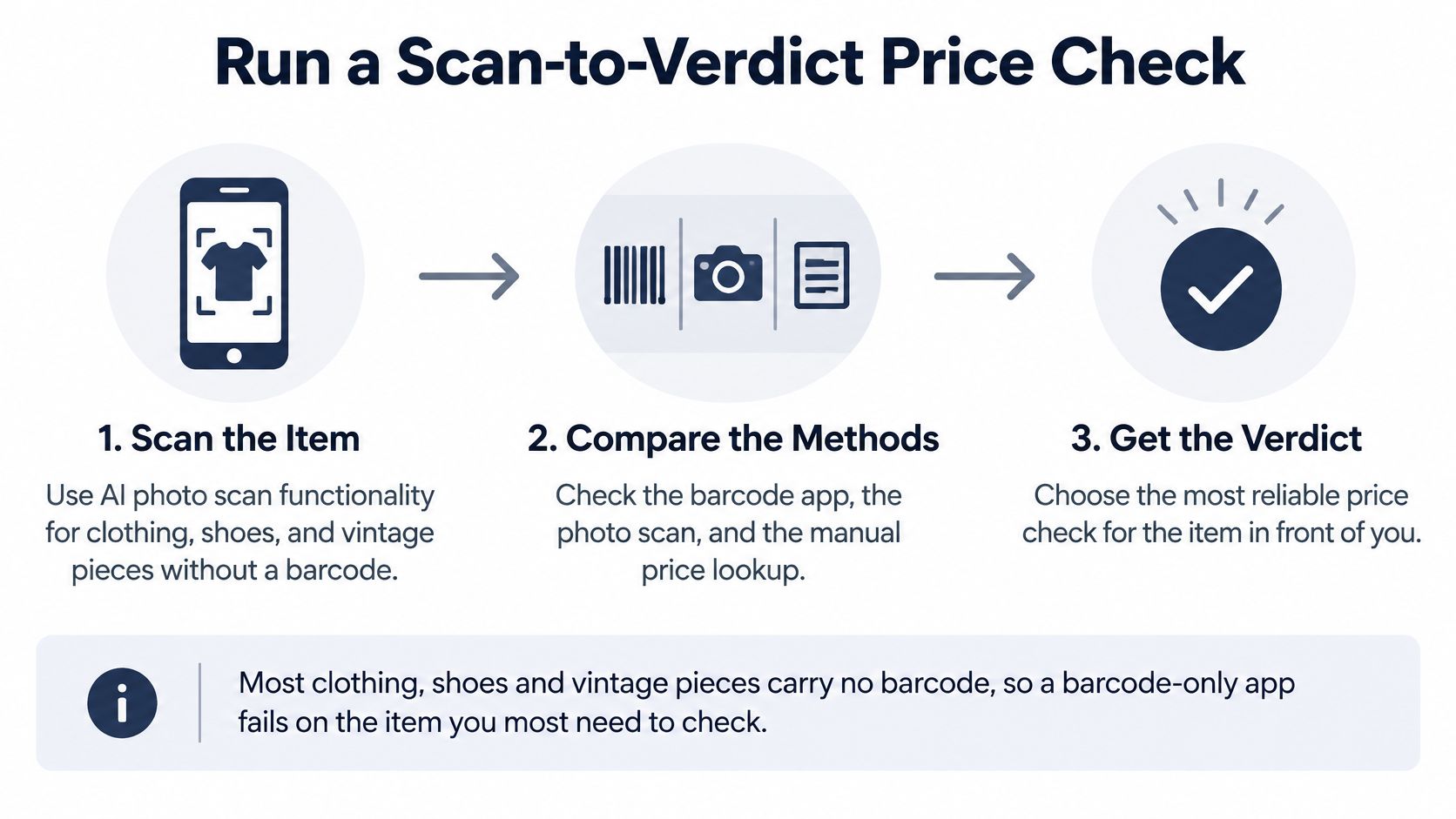
A thrift rack exposes the weakness of barcode-only sourcing. Most clothing, shoes, and vintage pieces carry no usable product barcode, so the app that handles boxed retail easily can fail on the jacket you need to identify.
Our app, ScanFlip AI, provides AI photo identification without a barcode, barcode scanning, and text search. Its core workflow is scan, compare real-time sold comps across six major reselling platforms, and calculate take-home after fees and shipping.
Which scan method fits which item
| Scan method | Works best for | Watch for | Example |
|---|---|---|---|
| AI photo scan | Clothing, shoes, vintage, collectibles, and electronics with no barcode | Needs a clear shot of the item and its label | Untagged vintage jacket on a thrift rack |
| Barcode scan | Books, media, games, and boxed retail with a UPC | Useless on untagged or handmade items | Paperback on a $1 cart |
| Text search | Items you cannot photograph or scan, searched by name | Requires a precise name and size | Named cast iron skillet on a clearance shelf |
The quickest method isn't always the right method. A barcode can identify a retail product but still miss a condition problem, while a photo can recognize the general object without proving the exact model.
Use this flow as a starting point, then verify the identification yourself.
Follow the item through the calculation
Choose the method that fits. Photograph an untagged jacket, scan a boxed game's UPC, or search a model name. The common slip is forcing every item through the barcode scanner.
Confirm the identification. Match model, size, material, edition, and included accessories. Skipping this check can turn a visually similar item into a completely misleading profit estimate.
Review sold comps, not asking prices. Look at what buyers purchased. The slip is treating an optimistic active listing as evidence that your item will sell.
Choose your intended platform. Use the marketplace where you can realistically reach the relevant buyer. Don't select a platform solely because it displays the highest gross result.
Enter buy cost and expected shipping. Our automatic profit calculator computes fees and shipping to show take-home from those inputs. Forgetting the box, protective packaging, or seller-funded postage makes that answer less useful.
Read net profit against your minimum. The red/green flip-or-pass verdict needs a threshold that reflects your sourcing standards. Accepting the signal without checking the underlying assumptions is the common mistake here.
Save the scan with its photo, store, and time. Scan history helps you review where worthwhile finds came from. Saving without checking the location makes later sourcing comparisons less useful.
For the phone-in-hand routine, use our scan-to-buy workflow. If results look scattered, change the method and rescan rather than averaging unrelated products into a confident-looking number.
For watches and other condition-sensitive collectibles, Idaho Pawn & Gold Exchange's guide to what sellers net after fees is another useful category-specific reference. Identification, condition, and the selling channel all deserve attention before you trust a valuation.
Reading Sold Comps Without Getting Fooled
The single highest sold comp is usually the wrong sourcing benchmark. It may represent exceptional condition, a desirable size, authentication, or accessories your item doesn't have.
I would pull roughly ten to twenty recent sold results when enough relevant sales exist, then remove results older than a few months unless the category is especially thin. That's a working method, not a reason to pretend a rare collectible has abundant evidence.
The details worth matching aren't always obvious from a thumbnail.
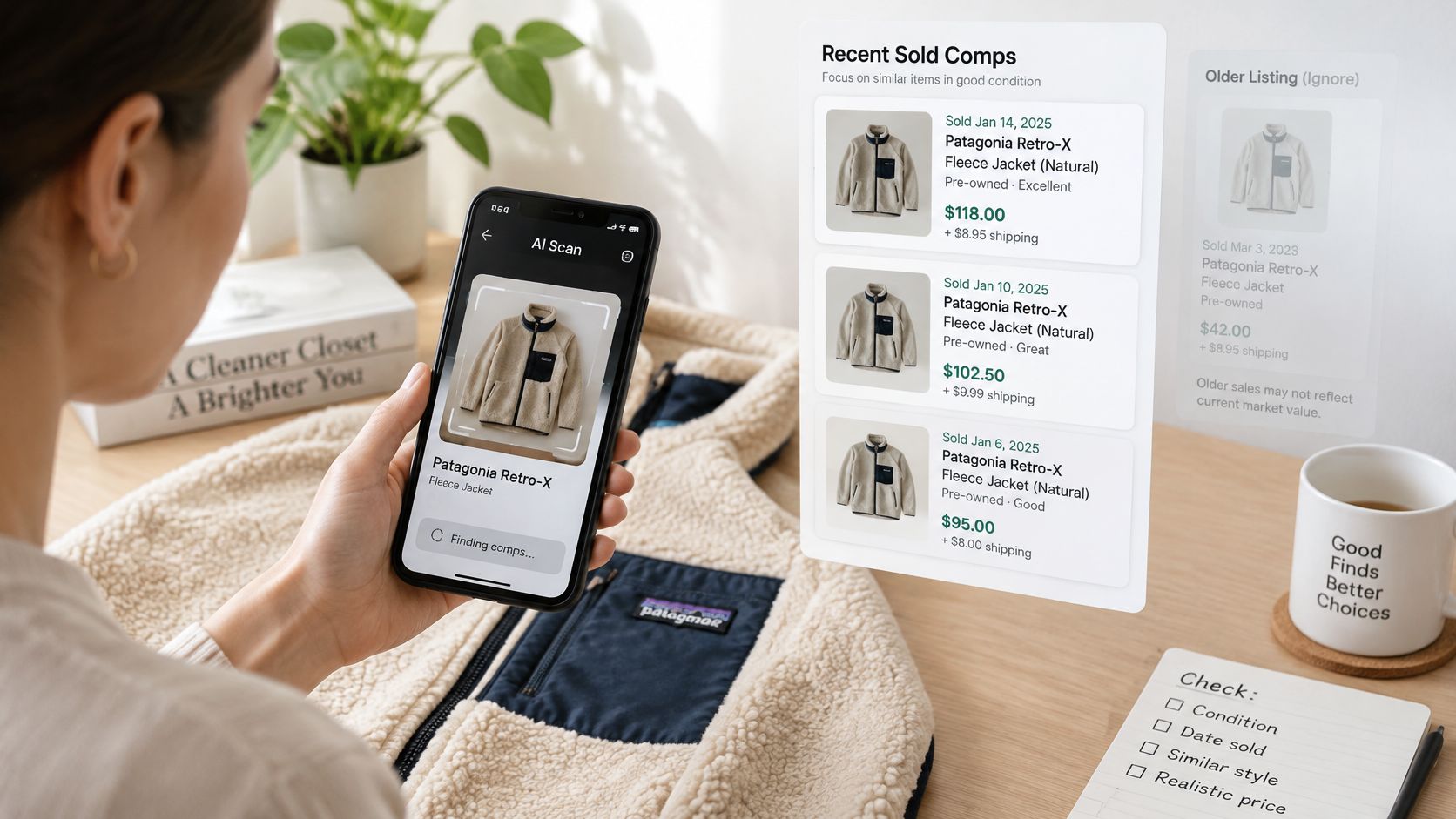
Clean the comparison set
- Match the actual product. Separate similar model names, revisions, sizes, and materials. A familiar brand isn't enough.
- Remove special transactions. Bundles, signed pieces, graded cards, complete sets, and unusual accessories need their own comparison group.
- Match condition carefully. New with tags isn't a useful direct comp for a worn piece. Check stains, missing parts, battery health, and repair needs.
- Check timing. Seasonal demand and temporary attention can make an older sale less useful for an item you're buying today.
For electronics, myhalo's guide to prepare your laptop for a better offer provides a relevant preparation checklist. A complete, tested laptop and an untested machine missing its charger shouldn't share a valuation just because their model names match.
Take the median of the clean sold comps, then check whether sales happen often enough to justify tying up cash. For a consistent observation window, use sell-through rate, or STR, as sold divided by sold plus active listings. Keep the filters and time window consistent; otherwise the ratio won't tell you much.
Compare the buyer pool, not just the price
Our real-time comparison covers six core platforms: eBay, Poshmark, Mercari, Depop, Amazon, and Whatnot. Broader marketplace checks can also include ThredUp, Facebook Marketplace, and TikTok Shop, with attention to whether the available evidence represents completed sales.
A garment can produce better sold prices on Poshmark than eBay without delivering better net profit. For manual checks, our guide to finding sold prices on eBay helps separate completed-sale evidence from active listings.
Record the median, the number of relevant sales, and the platform with the best realistic net. A BOLO name without that context can become expensive death-pile inventory.
Worked Scenarios from Thrift Racks and Clearance Aisles
The Goodwill piece that barely pays
Say you find a top at Goodwill for $3, and the relevant Poshmark sold comp is $12. Applying the commission schedule to this hypothetical purchase leaves $9.05 before cost of goods, then $6.05 after the purchase.
That's before supplies, cleaning, photographing, measuring, and handling an offer. If your minimum net is higher, leave it on the rack rather than explaining away the shortfall.
The fee boundary also makes nearby sold prices worth checking carefully:
| Hypothetical sold price | Commission | Proceeds before cost of goods |
|---|---|---|
| $14.99 | $2.95 | $12.04 |
| $15.00 | $3.00 | $12.00 |
| $19.99 | Approximately $4.00 | $15.99 |
A slightly higher sale doesn't always mean higher proceeds at the boundary. None of these proceeds figures is net profit until you subtract the purchase and other seller-paid expenses.
The Ross clearance box that ships badly
Now take a hypothetical $10 heavy item with a $35 sold comp on a Ross clearance rack. Before shipping, applying the item-only commission leaves $21.50 after cost of goods. That figure isn't permission to buy, because the shipping arrangement still needs to be calculated.
Mercari's seller-protection policy distinguishes prepaid-label shipping from independent shipping and describes tracking and shipping protection. For sourcing, establish the packed weight and dimensions, not just the weight printed on the retail package.
Weigh the item with a suitable box and protective material before paying whenever possible. If you can't establish shipping cost in the store, use a conservative packed estimate or pass.
Cheap inventory isn't cheap if the box consumes the profit.
These cases have the same practical outcome: the sold comp starts the calculation, but the net decides whether the item deserves space in your cart.
Set Your Threshold and Decide Before You Pay
A price check is only useful when the minimum is fixed before the scan. If the threshold changes after you see a promising comp, the app becomes a way to justify the purchase.
For a hypothetical $15 minimum net profit, test the same garage sale item against best-case, typical, and conservative outcomes. Keep the illustrative eBay rate, seller-paid shipping, and purchase cost constant so the verdict changes only because the expected sale changes.
Best, typical and conservative verdicts at a $15 threshold
| Scenario | Sold price | Verdict at $15 threshold |
|---|---|---|
| Best case, top recent sale | $42 | Green, clears with $25.53 net |
| Typical, median of clean sales | $35 | Green, clears with $19.46 net |
| Conservative, low end of clean comps | $25 | Red, fails with $10.79 net |
These worked estimates subtract the percentage fee, per-order charge, shipping, and cost of goods, with rounding to cents. They don't include additional supplies, promotions, taxes in the fee base, or a return allowance.
The conservative row fails. I would pass at that purchase cost, even though the top sale looks attractive and the typical outcome clears the threshold. A green result on the strongest comp alone does not protect the margin when weaker demand or a necessary discount pulls the sale lower.
Account for downside without pretending to predict it
The National Retail Federation's returns projection estimated that 19.3% of online purchases would be returned in 2025. That figure describes online retail broadly rather than your personal resale return rate, but it is a useful reason to reserve part of the expected profit instead of treating every completed transaction as permanently earned.
Build the allowance from the item and category in front of you. Fragile goods can create extra packing costs or arrive damaged. Fit-sensitive clothing can come back over size, and untested electronics can turn into disputes or lost value. A conservative price tests what happens when the sale is weak; the allowance accounts for what happens when the transaction itself goes wrong.
Neither adjustment pays for repairs or missing accessories unless you subtract those costs explicitly. A break-even price calculation establishes the floor, but break-even is not a sourcing target. Working for no profit still uses cash, storage, and time.
Make the decision before checkout
Before paying, complete the checks that can still change the answer:
- Confirm the category fee and per-order charge.
- Verify the packed shipping estimate, not just the item weight.
- Check condition, completeness, and any repair or cleaning cost.
- Enter the conservative sold price, then compare it with your minimum.
For seasonal inventory, recheck sold comps weekly rather than treating an old scan as a permanent valuation.
ROI matters, but it doesn't replace dollar profit or selling speed. A low-cost item can show an impressive return on cost while leaving too little money to justify testing, cleaning, packing, and buyer messages. A slower collectible may still work, but only if you're willing to tie up the cash and storage.
ScanFlip AI's Flip or Pass Verdict gives an instant red/green signal based on your set minimum profit margin. Feed it conservative inputs rather than the number you hope will make the purchase work.
If only the best or typical row clears your minimum, either negotiate a lower buy cost or leave the item. There will be other inventory.
If an item only works at the top comp, it is a pass.
Visit ScanFlip AI to check an item by photo, barcode, or text and compare sold comps with net profit after fees and shipping. New users get 10 free scans with no credit card required, so test your next aisle find against a conservative price and your own minimum before you pay.