
Cash Flow Management for Resellers That Actually Works
You've got $800 in your resale account, a Goodwill trip planned, and three packages waiting to ship. Then you check the dashboard and realize $420 in sales hasn't cleared yet. The problem isn't that you failed to sell. The problem is that your money is moving on a different schedule than your sourcing plans.
Cash flow management for resellers starts at the rack, bin, or estate-sale table. Every purchase uses cash that could fund the next BOLO, cover shipping supplies, or keep you operating through a slow week. Inventory is cash in disguise, and a death pile is money that can't buy anything until it sells.
Table of Contents
- The Cash Crunch Every Reseller Hits Eventually
- The Three Cash-Flow Numbers Resellers Should Track
- Build a Rolling 4-Week Cash Flow Forecast
- Daily and Weekly Routines That Keep You Liquid
- Inventory and Sourcing Rules That Free Up Cash
- Why Cash Flow Is Really a Buy-Decision Problem
- Your Contingency Plan and Cash Flow Checklist
The Cash Crunch Every Reseller Hits Eventually
A flipper does $4,800 in gross sales during a strong month. That sounds healthy until the next sourcing weekend arrives. Marketplace payouts haven't all landed, fees and shipping have already come out, and a large part of the inventory is still sitting in a death pile waiting for photos, measurements, or a better season.
They can't comfortably cover the next trip, even though the sales dashboard looks impressive.
That's a timing problem, not automatically a profit problem. Gross sales tell you what sold. Cash flow tells you when money reaches your account, when you have to pay for shipping and supplies, and how much remains available for another buy.
Reselling makes this timing harder than a business with predictable monthly invoices. Revenue comes in uneven waves. A garage-sale weekend can produce a strong batch of sales, followed by a quiet stretch. An estate sale may require travel and a larger purchase all at once. An auction pickup, storage-unit bid, or pallet opportunity can consume cash before the previous batch has converted into payouts.
Profit on paper versus money available
A $50 purchase can be profitable and still be the wrong purchase today. If that $50 sits in a slow-moving collectible for months, it has an opportunity cost. You can't use it on the pair of shoes that sells quickly, the book lot with strong sold comps, or the unplanned estate-sale find that appears tomorrow.
That distinction matters across small businesses. A Federal Reserve Small Business Credit Survey benchmark summarized by Crestmont Capital found that 43% of small businesses experienced cash-flow-related financial challenges in the prior 12 months, while 51% had less than one month of cash reserves. The same source cites the widely referenced U.S. Bank finding that 82% of business failures are tied to poor cash flow management. These figures describe small businesses broadly, but resellers feel the underlying problem at the point of purchase.
What liquidity changes at the source
You don't need a complicated accounting system to start. You need to know how much cash is available, how soon expected payouts should clear, what expenses are unavoidable, and how much inventory you can responsibly buy today.
The rest of the system is simple:
- Protect available cash: Keep enough for shipping, gas, supplies, storage, and the next sourcing opportunity.
- Buy for conversion: Favor items with credible sold comps, acceptable sell-through, and enough net profit after fees and shipping.
- Create exit rules: Move stale inventory instead of letting low-cost purchases become a permanent death pile.
Cash flow management isn't about restricting every flip. It's about staying liquid enough to keep sourcing when the right item appears.
The Three Cash-Flow Numbers Resellers Should Track
Most resellers don't need a finance dashboard packed with ratios. Three practical numbers answer most buying questions: cash buffer days, sell-through rate, and net profit per flip.
Cash buffer days
Define this in reseller language: how many days of sourcing and shipping can I cover without selling a single item?
Suppose you have $600 spread across your PayPal, eBay, and Poshmark accounts. Your fixed monthly costs are $200 for gas, supplies, and storage. At that spending rate, the simple buffer calculation is:
$600 ÷ $200 × 30 days = 90 days
That isn't a guarantee that your cash will last 90 days. It's a baseline based on the expenses you included. If you add large sourcing trips, platform deductions, returns, or unexpected equipment costs, the buffer gets shorter.
The JPMorgan Chase Institute's small-business liquidity research popularized cash buffer days and found a median buffer of about 27 days for small businesses. The historical cash-flow benchmark summarized by Invopilot explains why this measure matters. Profit can look fine while the available runway remains short.
Sell-through rate
Sell-through rate shows whether your inventory is converting or just occupying shelves.
Sell-through rate = units sold ÷ units listed during the same window
If you had 120 listings and sold 42 during 30 days:
42 ÷ 120 = 35% STR
Use comparable windows and categories. A 35% overall rate can hide a dead category, an overpriced group of listings, or a batch that hasn't been photographed properly. Don't use listing prices to judge demand. Use sold comps and your own completed sales.
Net profit per flip
Net profit is the number that tells you whether a purchase deserves your cash.
Example:
- Sold comp: $24.99
- eBay fees at 13%: about $3.25
- Shipping: $7.50
- Cost of goods: $3.50
- Approximate net profit: $10.74, or roughly $10.50
The actual amount can vary with the final fee calculation, shipping label, refunds, and other costs. The point is to subtract the expenses before buying, not after the item is already in your cart.
For a deeper framework, compare your own numbers with reseller sourcing performance metrics. These three measures work together. Buffer days tell you what you can spend, sell-through tells you how quickly inventory becomes cash, and net profit tells you whether each flip is worth funding.
Build a Rolling 4-Week Cash Flow Forecast
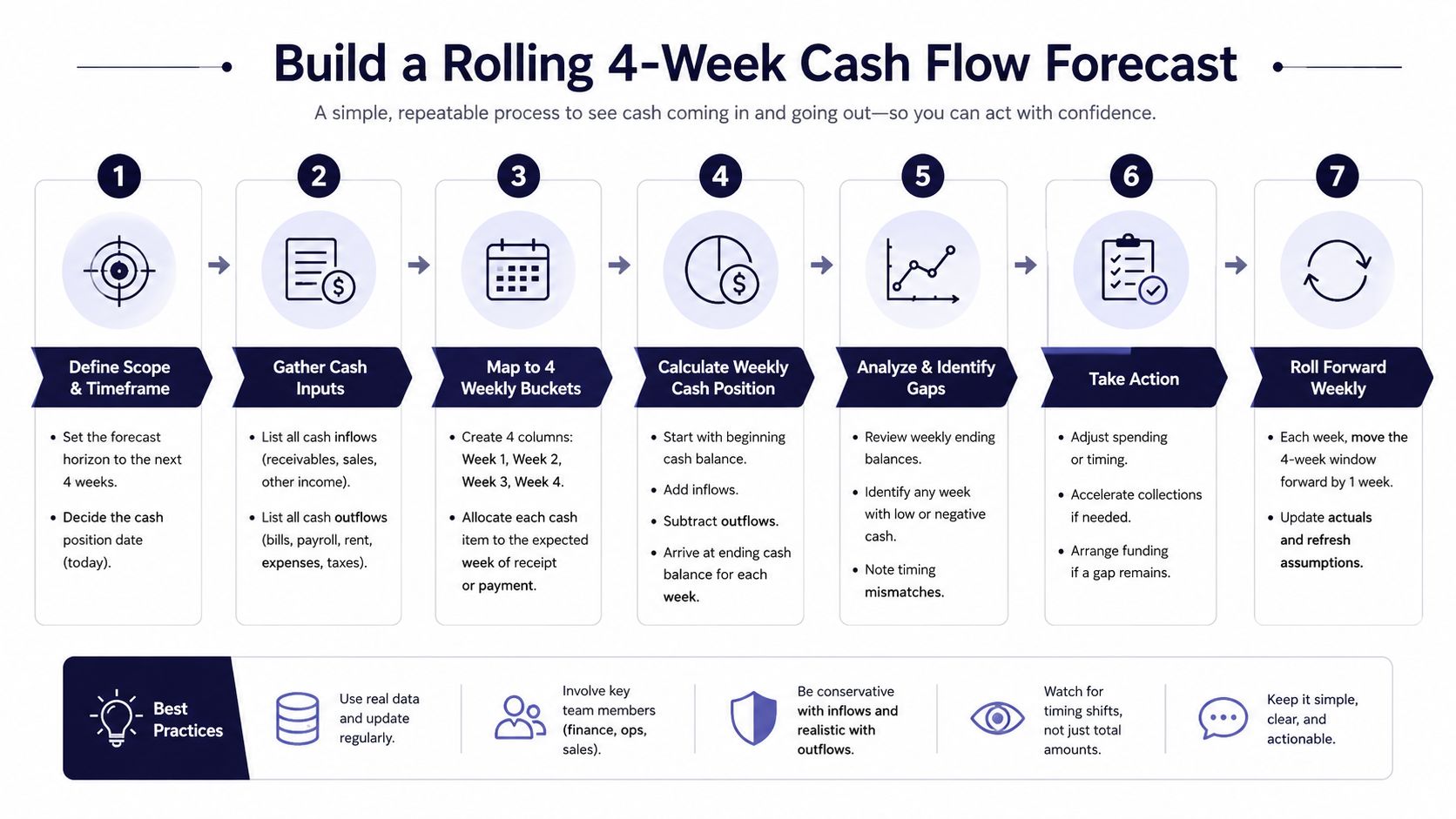
A rolling forecast can live in one Google Sheet. You don't need accounting software or a complicated monthly budget. You need a current view of what should enter, what must leave, and what your balance will be after both happen.
Use five columns:
- Week
- Expected inflow
- Expected outflow
- Running balance
- Stop-buying trigger
Expected inflow includes marketplace payouts you reasonably expect to clear. Expected outflow includes sourcing, shipping supplies, gas, storage, fees, and other expenses that will leave your account. Keep projected sales separate from cleared payouts. A sold item isn't available cash until the payout becomes usable.
A simple four-week example
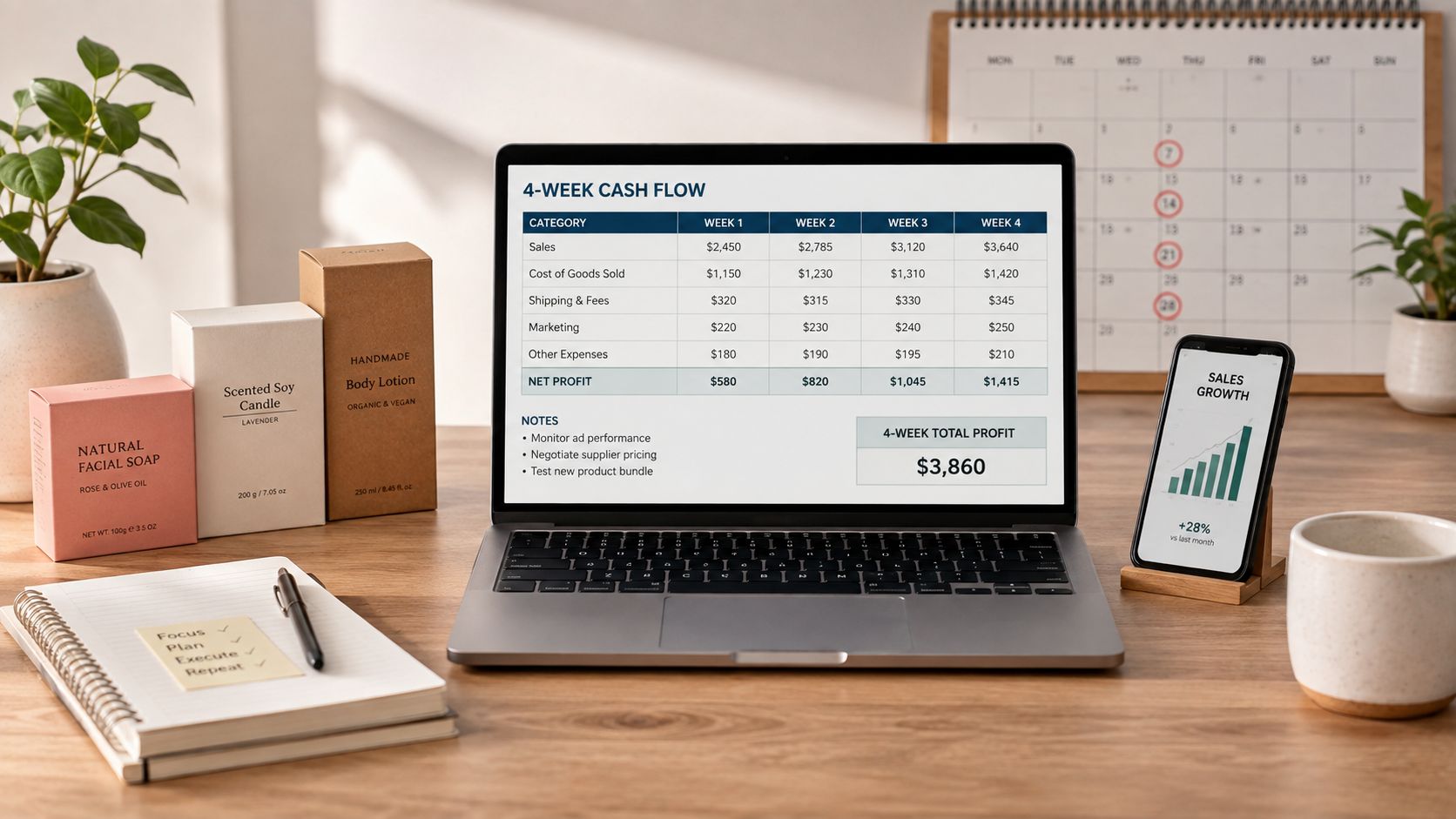
Start with $800.
| Week | Expected inflow | Expected outflow | Running balance | Stop-buying trigger |
|---|---|---|---|---|
| Week 1 | $420 | $350 | $870 | $600 |
| Week 2 | $300 | $250 | $920 | $600 |
| Week 3 | $180 | $400 | $700 | $600 |
| Week 4 | $350 | $200 | $850 | $600 |
The Week 1 balance is $800 + $420 − $350 = $870. The $350 outflow might include a planned thrift run, shipping supplies, and gas. If the running balance falls below the trigger, you pause discretionary sourcing rather than hoping the next sale arrives on schedule.
A monthly budget hides this pressure. A strong thrift-store weekend can use a month's planned runway in one outing, especially when you find several promising items at once. Weekly forecasting forces the decision into the same time frame as your buying.
If the forecast shows red next week, you don't have a forecast problem. You have a buying problem.
Update the sheet with reality
At the end of each week, replace estimates with actual payouts and actual spending. Then extend the forecast by one additional week. Your forecast won't be perfect because sell-through and payout timing are estimates. Fees, shipping labels, storage charges, and scheduled subscriptions are easier to predict, so use conservative assumptions for those hard costs.
Seasonality also deserves a place in the sheet. Research summarized by Trezy's report on summer payment slowdowns describes payment timing as a factor that can affect hiring, investment, and borrowing decisions. For a reseller, the equivalent decision is whether to spend $200 on inventory today or preserve cash until payouts catch up.
Daily and Weekly Routines That Keep You Liquid
Cash flow surprises usually come from skipped checks, not complicated math. A five-minute daily review and a 30-minute weekly review are enough for most side-hustle sellers to spot trouble before the next sourcing trip.
The five-minute daily check
Open each marketplace dashboard and note pending payouts. Don't count a sale as spendable money until you know when it clears and whether a return, hold, or adjustment could affect it.
Then glance at the running balance on your forecast sheet. Ask one question: if I buy nothing today, can the current cash cover the expenses already scheduled?
If the answer is no, pause discretionary purchases. Ship what's sold, list the easiest items in the death pile, and wait for the forecast to recover.
The Sunday review
My preferred routine is simple: Sunday night, 8pm, coffee, the four-column sheet, 30 minutes.
Update last week's expected inflow against actual cleared payouts. Do the same with sourcing, supplies, gas, fees, and storage. Then look for changes in category performance. If clothing sell-through has dropped while books are converting, the next sourcing budget shouldn't treat both categories equally.
The final step is deciding next week's spending limit. Set it after accounting for mandatory outflows, not before. A good sourcing budget is the amount left after protecting your operating cash.
| Task | Cadence | Time Needed | What It Tells You |
|---|---|---|---|
| Check pending payouts | Daily | 5 minutes | What cash is likely to clear soon |
| Review running balance | Daily | 1 minute | Whether today's spending is safe |
| Replace estimates with actuals | Weekly | 10 minutes | Where the forecast was wrong |
| Check category sell-through | Weekly | 10 minutes | Which sourcing areas deserve cash |
| Set next week's buy limit | Weekly | 10 minutes | How much you can spend without crossing the trigger |
Sellers often say they don't have time for this. Usually, the skipped review creates the exact cash crunch that consumes more time later. You end up scrambling to liquidate stale items, delaying shipments, borrowing for supplies, or canceling a sourcing trip that had better potential than the emergency fix.
Use the weekly review to check cleared payouts, actual expenses, running balance, sell-through by category, stale listings, returns, and the next sourcing cap. That's enough visibility to make a responsible buy decision.
Inventory and Sourcing Rules That Free Up Cash
Cash flow management gets practical at the point where your hand reaches for the cart. The rules below are intentionally strict because cheap items can still trap money when you buy too many of them.
Put a ceiling on each source run
Set a dollar cap before walking into the store or sale. A workable starting example is $150 per thrift trip and $300 per estate sale, adjusted to your actual buffer and forecast. Once you reach the cap, walk away, even if another item looks interesting.
The cap protects you from the “just one more” habit. It also forces prioritization. You'll choose the Coach bag with strong sold comps over the unverified sweater that only looks promising.
Liquidate stale low-cost inventory
For anything under $25 in buy cost, use a 30-day listed, not sold trigger. That doesn't mean every item must be dumped at any price. It means the item needs a decision: reduce the price, accept an offer, bundle it, move it to another marketplace, or donate it and recover the shelf space.
The key phrase is listed, not sold. An item sitting in a death pile hasn't had a chance to convert, while an item with weak activity after listing has given you information about demand, price, or presentation.
The working-capital logic is captured by the cash conversion cycle explanation from J.P. Morgan. The source describes an average CCC of about 52 days across growing companies and 30 days or less for best-in-class firms. For resellers, every extra day inventory sits delays the moment that purchase becomes usable cash.
Require a net-profit threshold
At a Goodwill Bins, you spot a Coach bag for $8. Sold comps show an average around $65. After marketplace fees and shipping, it nets roughly $48. That's an easy yes because the margin leaves room for normal friction.
Now consider a “maybe vintage” sweater at $6. The scan shows about $14, no reliable comps, and slow sell-through. It's a hard pass. Cheap isn't the same as cash efficient.
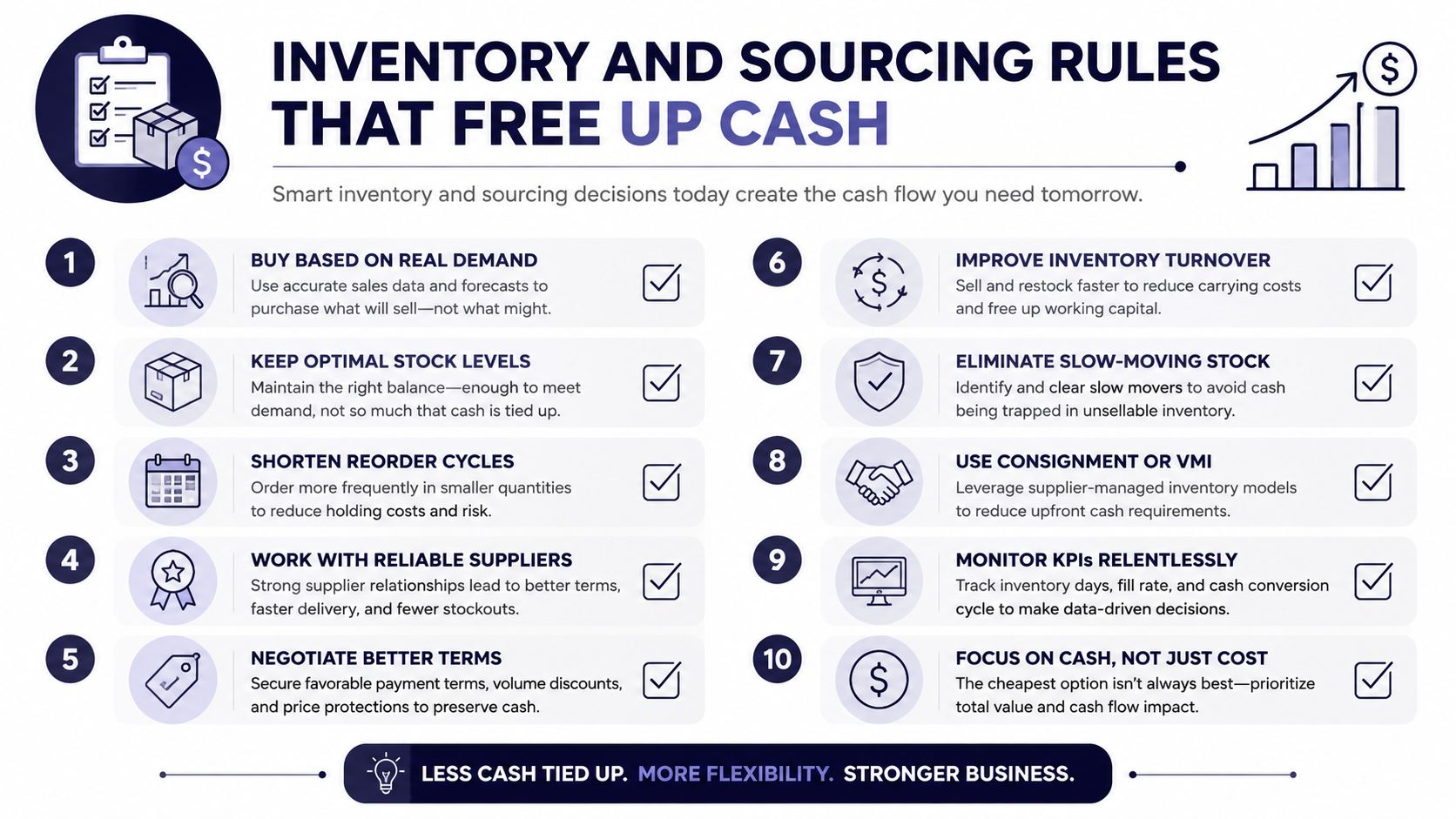
For a more detailed view of how to value stock before it becomes a death-pile problem, review inventory valuation methods for resellers. Every dollar in unsold inventory is unavailable for the next sourcing trip. The best buy isn't always the item with the highest possible sale price. It's the item with credible demand, sufficient net profit, and a reasonable path back to cash.
Why Cash Flow Is Really a Buy-Decision Problem
Many resellers treat cash flow as a savings problem. They try to keep more money in the account after overspending, but the more useful question comes earlier: should this money leave the account at all?
Every scan in a thrift aisle is a cash-flow decision. Spending $5 means $5 is unavailable for the next find. Spending $50 on a “maybe” creates 10 times the opportunity cost of spending $5 on that uncertain item. If the $50 purchase also moves slowly, the cost is more than the original buy. It includes the inventory space, listing time, packing effort, and missed sourcing options.
Decide before the purchase
A responsible source-side decision uses three checks:
- Demand: Are there credible sold comps, not just optimistic asking prices?
- Conversion: Does the item have a reasonable sell-through pattern for the category?
- Take-home: What remains after the buy cost, marketplace fees, and shipping?
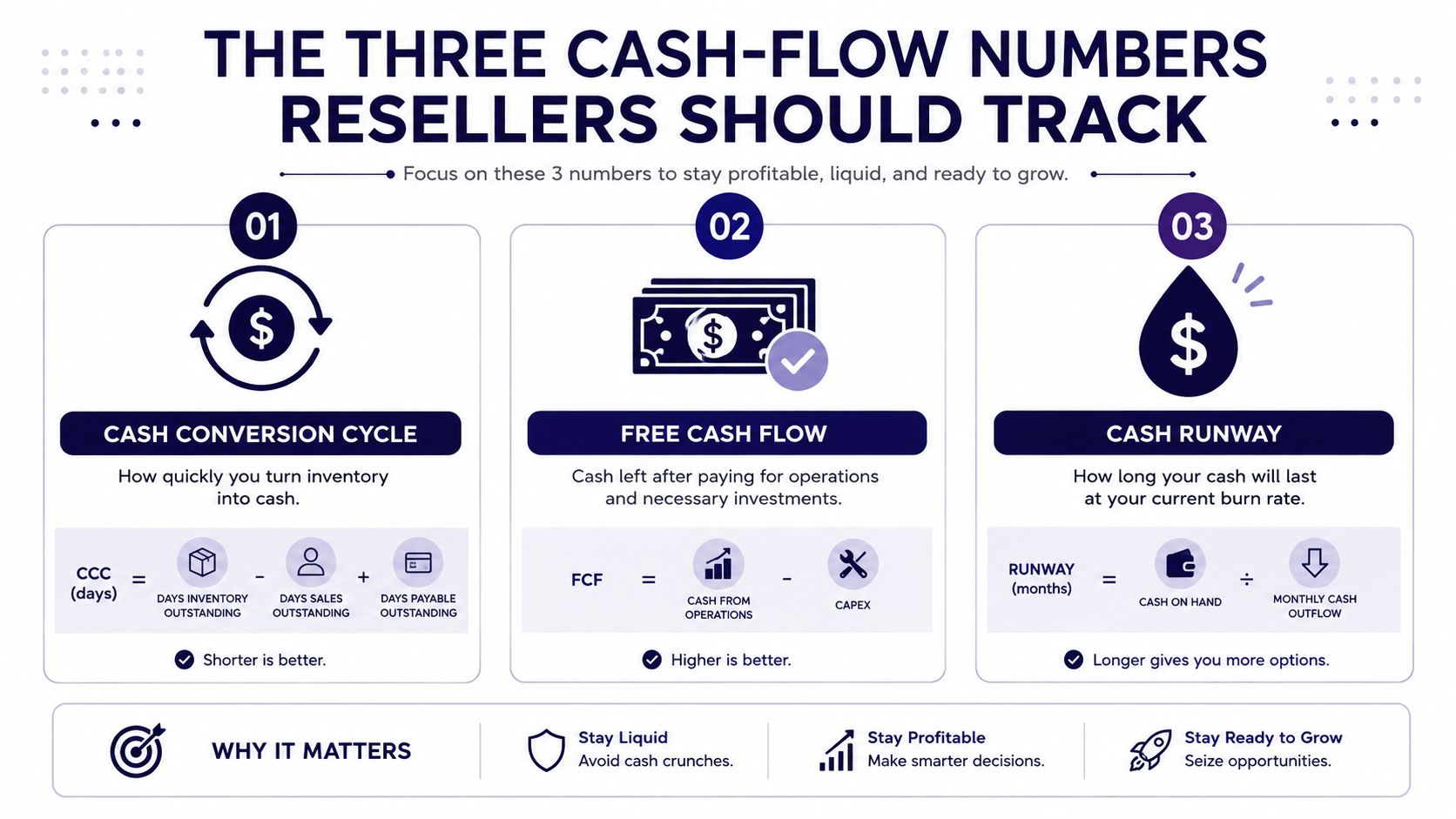
The cash conversion cycle is built from inventory time, collection time, and supplier payment time. Investopedia's cash conversion cycle reference gives the formula as CCC = DIO + DSO − DPO, where DIO measures inventory days, DSO measures collection days, and DPO measures supplier-payment timing. Resellers don't usually have supplier terms, but the inventory and collection pieces still matter. A purchase that sits unsold lengthens the time your money remains trapped.
Use tools where the decision happens
ScanFlip AI fits the sourcing phase because it offers three scan methods: AI photo scan with no barcode needed, barcode scan, and text search. It aggregates sold comps across eBay, Poshmark, Mercari, Depop, Amazon, Whatnot, ThredUp, Facebook Marketplace, and TikTok Shop, then calculates net profit after fees and shipping with a red or green flip-or-pass verdict.
That kind of information is useful when you're standing in the aisle and need to decide whether to spend the next $10, $50, or $200. The detailed mechanics of net profit are covered in this reseller net-profit calculation guide.
ScanFlip is a sourcing-phase tool, not a replacement for the tools you use afterward. Resellers may use Vendoo or List Perfectly for crosslisting and inventory workflows, while the buy decision remains separate. Better decisions at the source keep the forecast's running balance above its trigger line before a cash shortage develops.
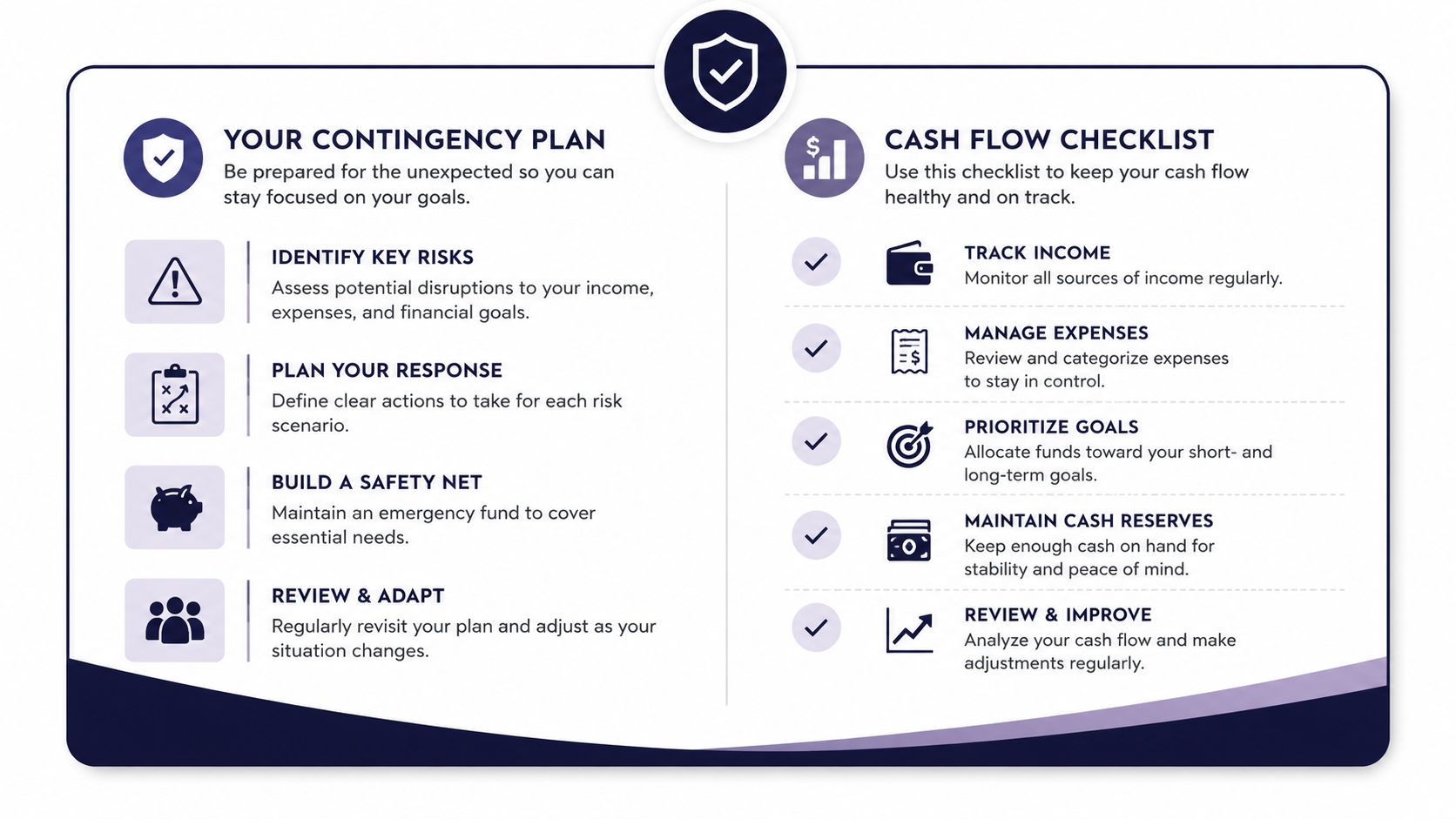
Your Contingency Plan and Cash Flow Checklist
A practical safety net has three layers.
First, build an emergency reserve of three to six months of essential operating expenses in a separate account, following the reserve guidance in this SCORE emergency-fund checklist.pdf). Base the target on essential costs, not an aspirational sourcing budget.
Second, define slowdown triggers before you're stressed. A falling sell-through rate, shrinking buffer days, or a forecast that drops below your minimum balance means pause buying for a week. It doesn't mean your business is finished. It means cash needs time to catch up.
Third, set a debt ceiling. Don't use credit cards or buy-now-pay-later financing for inventory beyond a dollar limit you can repay without depending on an immediate sale. Debt can hide a weak buying decision until the payment comes due.
Cash flow checklist
- Forecast: Updated every week
- Minimum buffer: $600 in the worked example, adjusted to your expenses
- Source cap: $150 per thrift trip or $300 per estate sale in the worked examples
- Scan rule: Every purchase shows acceptable net profit before you buy
- Stale inventory: Apply the 30-day listed, not sold rule to items under $25 in buy cost
- Reserve: Keep three to six months of essential expenses separate
Cash flow management isn't about restricting flips. It's about making sure there's always cash to flip with next week.
ScanFlip AI helps resellers make the sourcing decision before money leaves their pocket, using AI photo scans without a barcode, barcode scans, and text search to compare sold comps and estimate net profit after fees and shipping. Visit ScanFlip AI to see how it can fit into your cash flow routine at the rack, bin, or estate sale.