
Depop Fee Calculator: Real Net Profit After Fees
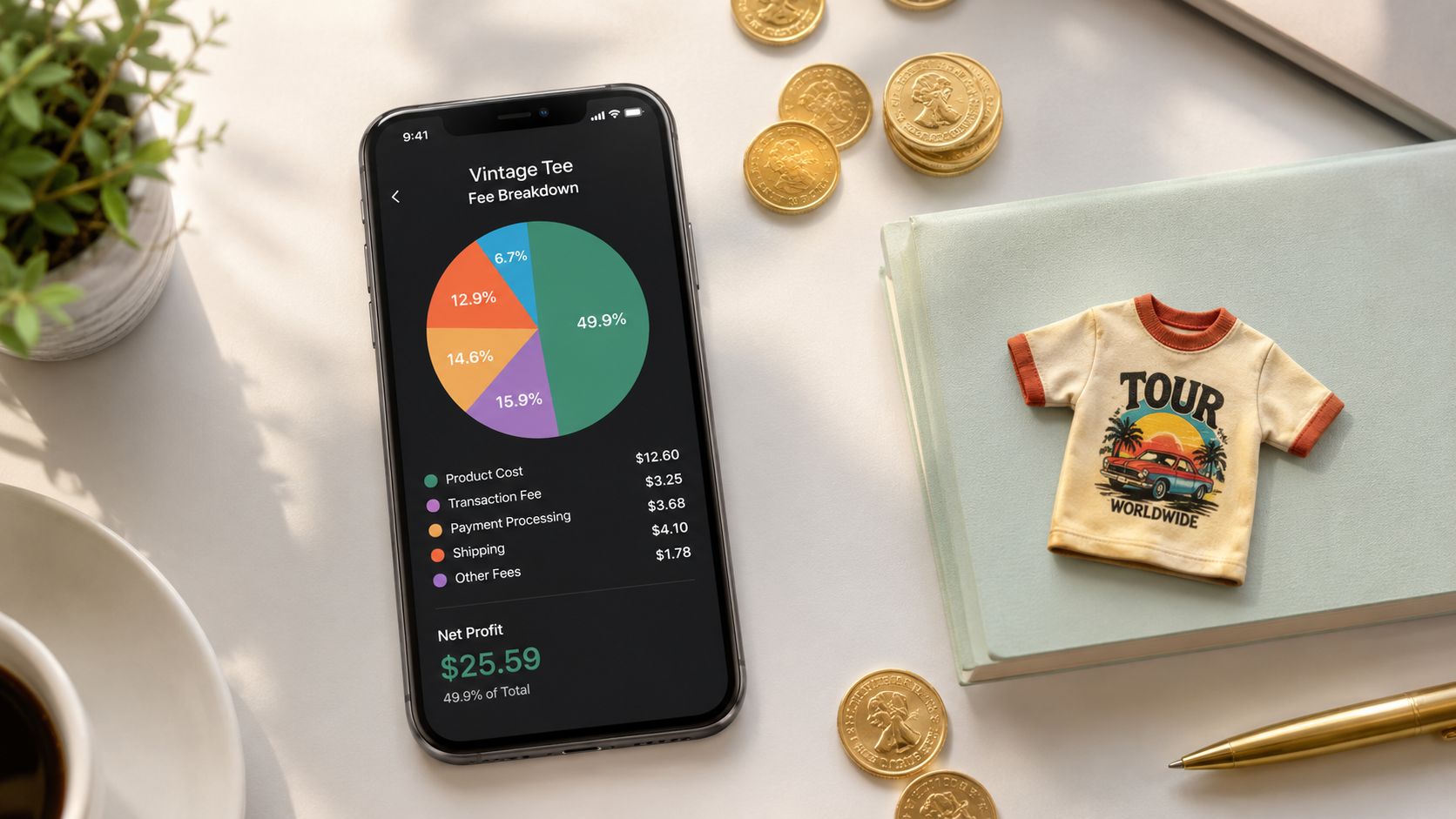
You list a $14 vintage tee, add $6 shipping, and think you're clearing around $9 after fees. Then the payout lands lower than that, because Depop takes its cut from the full checkout value, not just the shirt price, and the fixed processing fee stings a lot more on small orders than people expect. That's the part that burns resellers, especially on low-ticket flips and bundles where shipping eats margin.
A Depop fee calculator isn't just about checking a percentage. It's the difference between pricing for a clean payout and buying inventory that looks profitable on the hanger but nets almost nothing after processing, shipping, and optional boosts. If you've ever done the math after the sale and realized you underpriced by a couple of dollars, you already know why this matters.
Table of Contents
- The Sale That Looked Good Until You Did the Math
- How Depop's Fee Structure Actually Works in 2026
- Walking Through Real Calculations at Four Price Points
- The Fixed Fee Trap on Low-Price Inventory
- Modeling Bundles, Buyer-Paid Shipping, and Boosted Listings
- A Repeatable Calculator Workflow You Can Run in Your Head
- Building Net Profit Into Your Sourcing Decisions
- Common Fee Mistakes Resellers Still Make in 2026
The Sale That Looked Good Until You Did the Math
A $14 vintage tee feels like a decent little flip when you find it in a Goodwill aisle for a couple bucks. The problem shows up when the buyer pays $6 shipping, Depop processes the whole checkout, and the payout is smaller than the clean little profit you had in your head.
What the checkout really looked like
Practical rule: never price from the shirt price alone when the buyer is paying shipping. Depop's processing fee hits the whole order value, so that extra shipping money is part of the fee base.
Here's the simple version. The sale looked like $14 in revenue, but the actual checkout value was $20 once shipping got added, and the processing fee came out of that larger number. That's why the seller thought they'd clear about $9, then ended up with less cash in hand than expected after fees.
| Metric | Value |
|---|---|
| Item price | $14 |
| Buyer-paid shipping | $6 |
| Checkout value | $20 |
| Fees taken from checkout value | More than the shirt price alone suggests |
| Seller takeaway | Lower than the headline sale implies |
That's the whole problem in one table. Sellers fixate on sold comps and ignore the fee base, then wonder why a sale that looked fine on paper leaves almost no room for cost of goods, packaging, or a sourcing mistake.
If you sell on Depop regularly, this is the moment where the calculator stops being optional. The right question isn't “Did it sell?” It's “What did I keep after Depop took its slice from the full order?”
How Depop's Fee Structure Actually Works in 2026
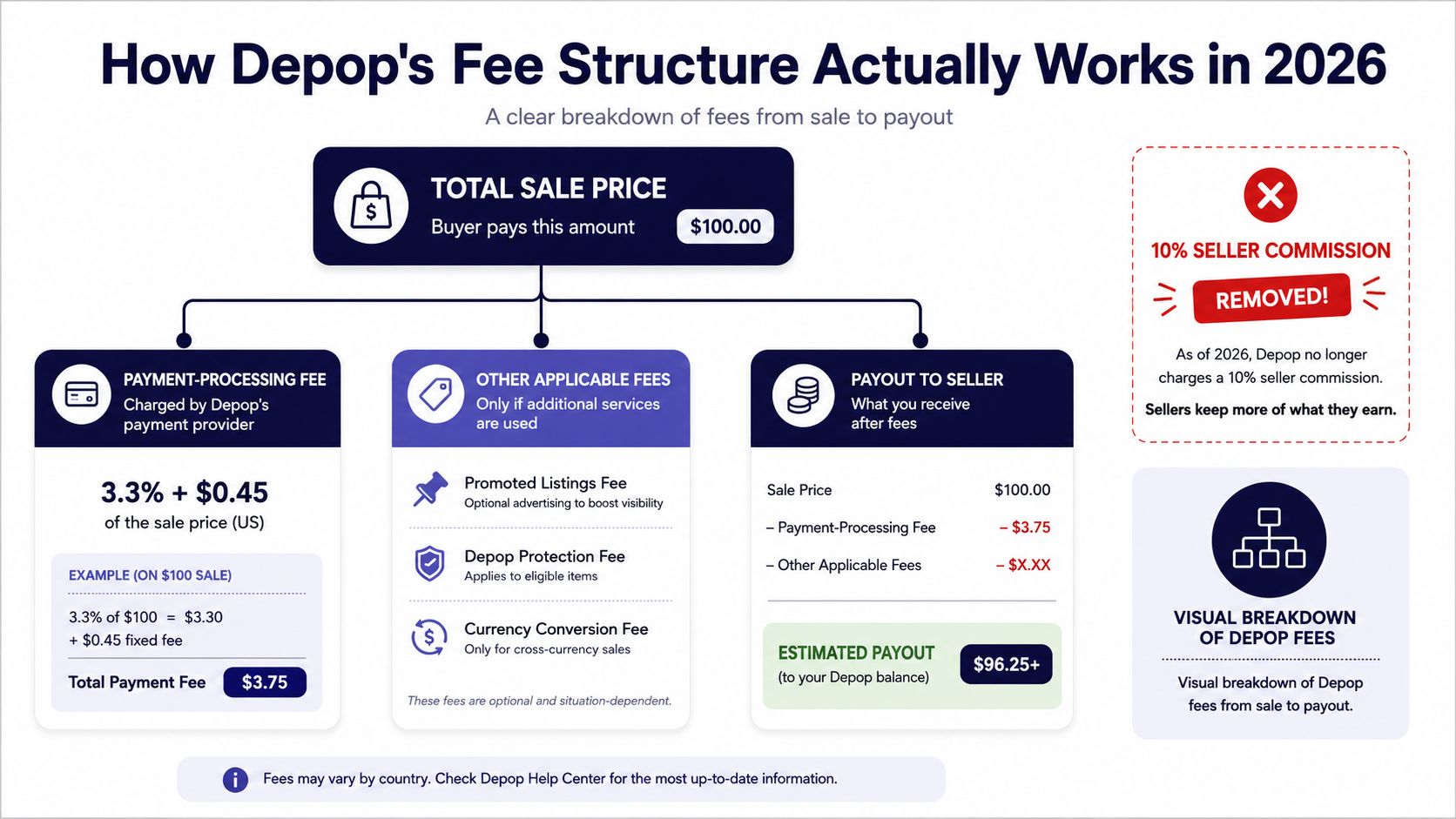
Depop's current setup is simpler than the old commission model, but sellers still get caught by the same mistake. They price from the item alone, then forget that shipping can sit inside the fee base, so the payout shrinks faster than expected. In the US, calculators based on Depop's schedule show sellers paying about 3.3% plus $0.45 per transaction, and in the UK it's about 2.9% plus £0.30 Depop fee calculator reference.
The fee lines you need to separate
The old 10% selling fee for new US and UK listings is gone on standard sales, so Depop's cut is lower than it used to be Depop fee calculator reference. That does not mean the order is cheap to process. The payment-processing fee is now the main line item to model, and it applies to the checkout value, not just the item price Depop fee calculator reference.
Practical rule: if the buyer pays shipping, include that shipping in your fee math. Forgetting that one detail is the fastest way to overstate margin.
Boosted Listings change the picture fast. Current calculators show an extra 12% boost fee on top of normal processing, and at least one calculator notes that boost can hit the item sale price and, if you do not use a Depop shipping label, also the shipping cost Depop fee calculator reference. That makes boosting a real margin decision, not a cosmetic one, especially on lower-priced inventory.
| Fee Component | Rate | Applies To | Optional |
|---|---|---|---|
| Seller commission | 0% on standard US and UK sales | Standard sale | No |
| Payment processing | About 3.3% + $0.45 in the US, about 2.9% + £0.30 in the UK | Checkout value | No |
| Boosted Listings | 12% boost fee | Item sale price, and sometimes shipping if no Depop label is used | Yes |
| Shipping-related charge base | Included in processing fee base | Buyer-paid shipping | No |
A reseller who wants a second point of comparison can use this Mercari fee calculator guide to see how another marketplace lays out the same kind of payout math.
Walking Through Real Calculations at Four Price Points
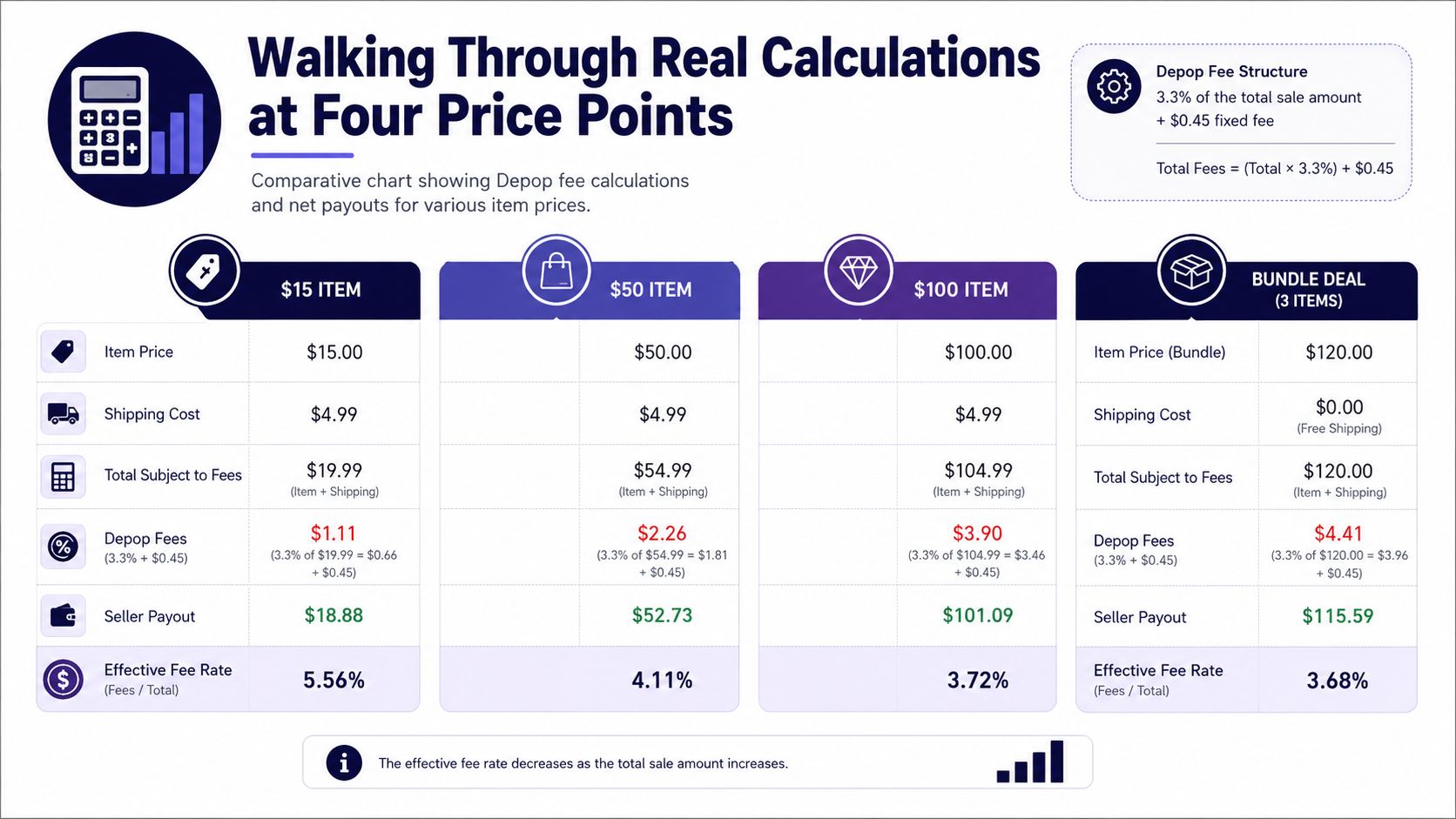
The cleanest way to judge a Depop sale is to stop staring at the sticker price and start modeling the checkout value. A calculator example shows a $50 US sale costing about $2.15 in fees, leaving $47.85 to the seller, which works out to an effective fee rate of roughly 3.8% Depop fee calculator reference. That matters because the percentage you feel on a $15 tee is not the same percentage you feel on a $100 jacket.
Why the effective rate changes
A fixed charge behaves very differently on a cheap sale than on an expensive one. On a small order, the $0.45 part is doing more of the work. On a bigger order, the percentage-based charge carries more of the load, and the fixed piece gets spread out.
The same calculator family notes that processing applies to the total order value, including shipping, so a seller who leaves shipping out of the math can overstate payout. That is how a listing that looks fine on paper turns into a thinner-than-expected result at checkout.
| Item Price | Shipping | Processing Fee | Seller Payout | Effective Rate |
|---|---|---|---|---|
| $15 | Included in checkout value if buyer pays shipping | Fixed processing plus percentage | Lower than headline sale suggests | Higher on small sales |
| $50 | Buyer-paid shipping counted in fee base | About $2.15 on the example sale | $47.85 | About 3.8% |
| $100 | Buyer-paid shipping can still raise fee base | Lower effective take than on cheap sales | Higher payout than low-ticket items | Lower than on small sales |
| Bundle | Depends on combined checkout value and shipping | Processing applies to the whole order | Net can shrink fast if cost of goods is high | Varies with the bundle |
The pattern shows up fast once you run real listings through the math. A $15 item can feel busy and still leave very little room after fees, while a larger sale can absorb the fixed charge without much pain.
Why bundles deserve their own math
Bundles are where sellers get sloppy. A few cheap items can look easy to move together, but the shipping charge and fixed processing fee can chew through margin faster than a single better-priced piece would. If the bundle is built from death-pile inventory with low cost of goods, that can still work. If the items were bought at retail, the margin usually gets tight in a hurry.
A good calculator run should answer one question fast. Would you still list the item if the payout lands where the math says it will, not where your gut hopes it will?
The Fixed Fee Trap on Low-Price Inventory
The $0.45 fixed charge looks harmless until it lands on a $10 to $15 item. On a $100 sale, it is a small line in the fee math. On a cheap tee, it can be the difference between a flip that leaves room for sourcing and one that barely covers the time you spent listing it.
Cheap inventory needs a different threshold
The trap is easiest to see when you compare the fixed fee at different price points. A calculator note points out that on a $10 sale, the $0.45 fixed piece alone is 4.5% of the order before you even count the percentage-based processing charge Depop fee calculator reference. That is why low-ticket inventory needs a break-even-first mindset instead of a generic fee summary.
| Sale Price | Fixed Fee | Fixed Fee as % of Profit |
|---|---|---|
| $10 | $0.45 | High relative impact |
| $15 | $0.45 | Still meaningful |
| $50 | $0.45 | Small impact |
| $100 | $0.45 | Minimal impact |
A cheap listing can look active and still be a poor use of capital if the fee load eats the margin.
Where the pricing strategy splits
A reseller who prices for gross sale keeps chasing what the market will tolerate. A reseller who prices for net profit starts with what the item has to return after fees, shipping, and cost of goods. The second approach takes more work at sourcing time, but it keeps you from stacking up a lot of $8 and $12 sales that feel busy and still do not move cash the way you expected.
If your margin disappears the moment shipping and the fixed fee hit the math, the item is not cheap inventory. It is bad inventory.
This matters even more when your sourcing cost is not close to free. A thrift find that costs a few dollars and sells for $12 can still be a pass if the payout turns into pocket change after Depop takes its cut. Depop can work fine for low-AOV items when the buy cost is low and the audience is right. It is not the place to force every marginal flip.
Modeling Bundles, Buyer-Paid Shipping, and Boosted Listings
A three-piece bundle can look clean on the rack and ugly in the payout screen. I've had small lots where the buyer paid $8 combined shipping, the pieces were cheap flips, and the checkout still got charged on the full order value. That means the shipping money is not outside the fee math just because it sits on a separate line.
Why boost changes the whole decision
Boosted Listings make the margin tighter fast. Current calculators show an extra 12% boost fee on top of normal processing, and at least one calculator notes that boost can apply to the item sale price and, if you do not use a Depop shipping label, also to shipping cost. On low-margin lots, that extra cut can turn a sale that looked fine into a payout that barely justifies the listing.
For the shipping side, use a practical guide like how to estimate shipping costs before you price the bundle. That estimate matters because a bad shipping guess and a boost fee can stack together and erase the room you thought you had.
A bundle only works when the net still makes sense
A 3-piece lot should only go live if the payout still clears your floor after all the friction. Item cost, combined shipping, processing, and any boost have to fit inside the margin you are willing to accept. If the math does not clear that bar, the lot belongs in the draft pile or split into separate listings.
The cleaner way to price a bundle is to start with the exact bundle count, the shipping method, and whether boost is on before you compare it with another platform. Sellers get burned when they compare the bundle to a sold comp and ignore the cost to ship it. On a low-AOV lot, that mistake can make a decent-looking sale feel busy while the profit disappears.
A Repeatable Calculator Workflow You Can Run in Your Head
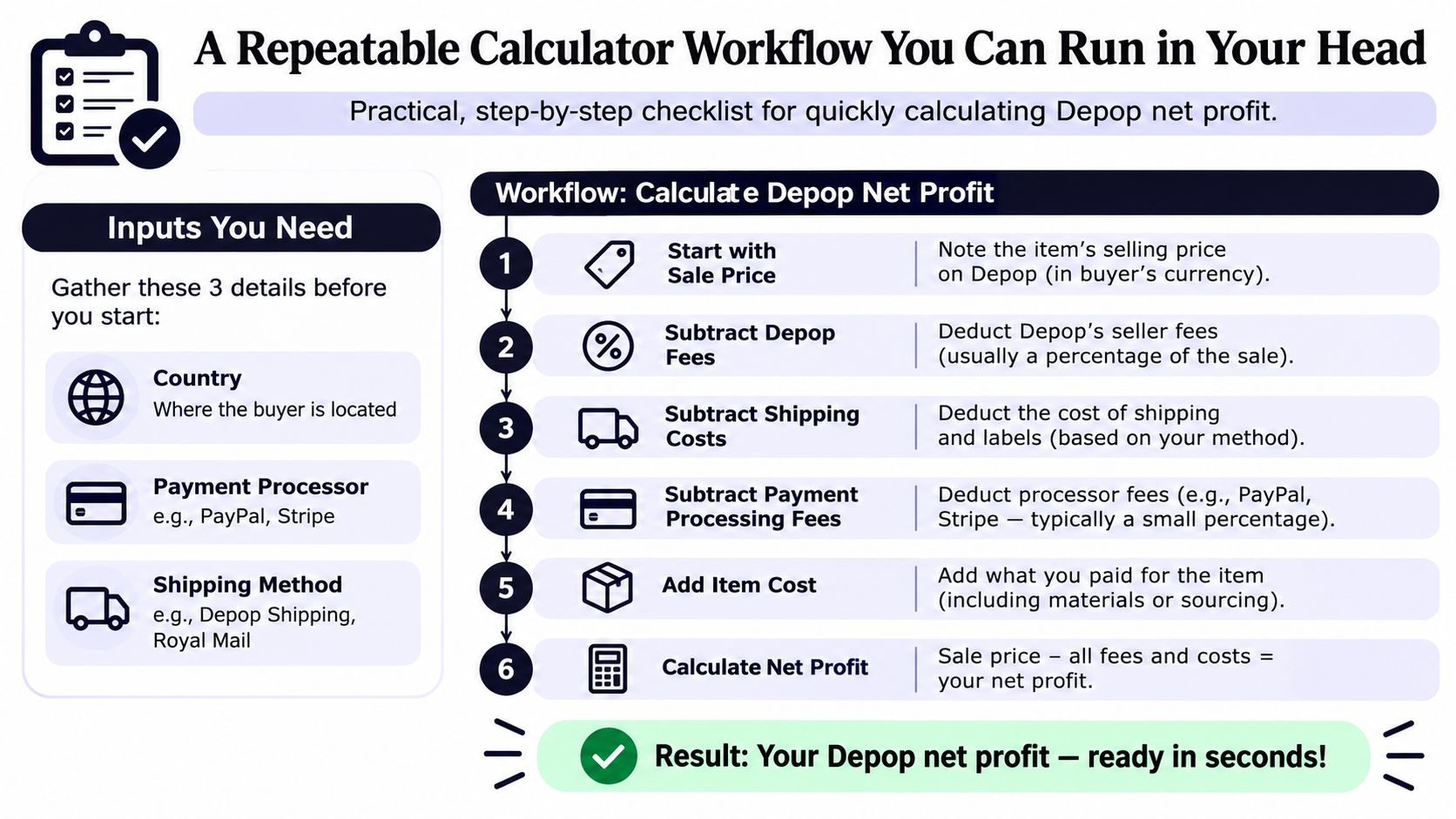
A Depop listing can look profitable right up until you account for the full fee base. I have been burned by that more than once, especially on items where I forgot to include shipping in the math and the payout shrank after the sale. The fastest way to avoid that mistake is to use the same inputs every time, in the same order, so you can see whether the item still leaves room after fees, shipping, and cost of goods. A practical calculator workflow is to enter the country, payment processor, shipping method, selling price, actual shipping cost, item cost, and whether the listing was boosted Depop fee calculator reference.
The mental order that keeps you honest
- Start with the selling price. That is the number buyers see, but it is not your profit.
- Add buyer-paid shipping if it applies. Depop includes it in the processing-fee base, so skipping it understates the fee.
- Apply the processing fee. Use the right country and payment setup, not a generic estimate.
- Subtract item cost. Gross sale means nothing if your buy-in was too high.
- Layer in boost only if it is on. That extra 12% changes the result fast Depop fee calculator reference.
- Compare the answer to your profit floor. If it misses, pass.
Why this beats guessing in the aisle
You can do this on a phone, in a notebook, or with an app while standing at the thrift rack. The point is to stop treating the sold price like profit. If you already use how to calculate net profit as part of your sourcing habit, the same logic works here with Depop-specific fees.
Simple rule: if you cannot tell me the net before you buy, you probably do not have a margin, you have hope.
That simple check is also where sourcing tools earn their keep. ScanFlip AI is one option resellers use at the aisle, because it scans three ways, pulls sold comps across multiple marketplaces including Depop, and shows a net profit verdict before money leaves your pocket. It helps with the buy decision, while crosslisters like Vendoo and List Perfectly still handle the separate job of listing and inventory management.
Building Net Profit Into Your Sourcing Decisions
Standing in a Goodwill aisle with a cart full of maybe-finds, the fee math needs to be simpler than the pitch in your head. A lot of resellers use a floor like minimum net profit or a minimum multiple of cost of goods, then pass on anything that falls below it after fees. That's how you keep from turning cheap inventory into a slow pile of almost-profit.
The buy decision should happen before the buy
If an item costs too much for the payout it can realistically produce on Depop, it's not a good flip. That's true even when the sold comps look decent, because sold comps don't pay your shipping or your processing fee. A strict threshold keeps you from chasing volume that only looks active from the outside.
An aisle-level tool earns its keep. ScanFlip AI lets sellers scan three ways, with AI photo scan that doesn't need a barcode, barcode scan, or text search, then checks sold comps across eBay, Poshmark, Mercari, Depop, Amazon, Whatnot, ThredUp, Facebook Marketplace, and TikTok Shop before showing a red or green flip-or-pass verdict. It's built for sourcing, not for listing.
Use the same rule across different sourcing spots
Whether you're in a garage sale bin, an estate sale room, or a thrift shelf, the same question applies. Will the item still hit your net after fees, shipping, and any boost decision you might make later? If not, leave it.
A decent sourcing rule doesn't need to be fancy. It just needs to be consistent enough that you stop buying items that will only clear a couple dollars after all the math settles.
Common Fee Mistakes Resellers Still Make in 2026
The bad listings usually start with a bad fee assumption. Some sellers still price like the 10% commission is sitting there in the background, then wonder why the math feels off. Others swing the other way and act like Depop is almost free, which gets ugly fast once processing hits the full checkout total.
A sale can look fine on the app and still leave you with a thin payout. I've had listings where the item price seemed safe, then shipping and the fixed processing charge ate more margin than expected. That is the part a lot of fee talk skips, and it matters most on low-AOV inventory and bundles.
The mistakes worth fixing right away
Boosting cheap items: The problem shows up when a sale looks decent but barely clears any profit. The extra 12% boost fee sits on top of normal processing, so a low-priced item can lose most of its margin before you notice it Depop fee calculator reference. I only boost when the added visibility has a real chance of moving a slow item, not when it just trims a $20 listing into a bad payout.
Forgetting shipping in the fee base: The payout lands lower than expected because processing applies to the full order value, not just the item price Depop fee calculator reference. If the buyer pays shipping, that amount still changes the checkout total. I learned that the hard way after listing a shirt at a price that worked on paper, then losing more to fees because I had ignored shipping in the calculation.
Assuming refunds behave like your mental model: Returns and canceled orders create confusion when sellers guess at reversal timing instead of checking the current payment flow. The fix is simple, review how Depop handles the payment side before you rely on a return plan. If you sell higher-risk items, that is not a detail to leave vague.
Using the same price everywhere: A price that works on one marketplace can fail on another because the fee math is different. Copying the same sticker price across platforms is how sellers end up with one channel carrying the whole margin while another barely breaks even. Price each listing from its own net, not from a generic comparable.
Ignoring tax collection differences: Your spreadsheet can say one thing while the payout says another because tax handling changes the checkout total. That changes the fee base, even when the item price stays the same. Model the full checkout value so you are not surprised by a payout that looks too low for no obvious reason.
Skipping bundle math: Bundles often feel safer because the order total is higher, but the fixed processing fee still has to be covered. A two-item bundle can be better than two separate low-priced sales, or it can just concentrate the same margin problem into one order. The only way to know is to run the bundle through net profit before you list it.
Depop gets easier once you stop pricing from hope. The sellers who stay out of trouble are the ones who check net profit first, then decide whether the item, the bundle, or the boost is worth it.